


Top B2B SEO & Growth Agency in Toronto: The All-in-One Pod

How many people have to touch your website before one SEO fix goes live?
Count honestly. Your SEO consultant notices that competitors own the “alternatives to” searches your buyers run, and you don’t have a page for them. That observation becomes a slide. Someone in marketing turns the slide into a ticket. The web agency quotes it. A copywriter drafts the page, a designer reworks the layout, and the developer waits for both. Six weeks later the page ships, and nobody remembers why it mattered.
For B2B companies, that chain is the hidden cost of search. Picking a top B2B SEO agency in Toronto used to mean finding the sharpest strategist. In 2026, the better test is how many handoffs sit between the strategy and your live site. This guide covers why B2B search punishes those handoffs, what a six-role pod looks like, and how to tell whether an all-in-one team fits your stage.
Why One SEO Fix Takes Six Weeks?
The handoff chain in that opening is how most B2B companies buy SEO. Strategy, content, design, and code each sit on a different budget line, with a different vendor and a different queue. The following are the three gaps where fixes usually stall.
- The report gap: an audit lands with dozens of issues and no owner for any of them. It gets read once and filed.
- The ticket gap: your developers are busy with product work, so SEO requests wait behind roadmap features and bug fixes.
- The context gap: the writer never spoke to sales, so the new page answers a question your buyers weren’t asking.
Each gap looks small on its own. Stacked, they turn a quarter’s plan into one or two shipped changes, and the rest sits in a spreadsheet. In a slow, crowded B2B market, that delay costs more than it seems, and the Toronto market is about as crowded as it gets.
What B2B Buyers in the Toronto-Waterloo Corridor Expect From Search?
Those stalled fixes hurt most where competition is dense, which describes the corridor from downtown Toronto to Waterloo Region. More vendors chasing the same buyers means every month a page sits unbuilt is a month a rival’s page gets read instead. Here’s what that market looks like and what its buyers do before they ever book a demo.
According to CBRE’s latest Scoring Tech Talent report, as reported by CP24 in August 2026, Toronto ranks third in North America for tech talent, behind only the San Francisco Bay Area and Seattle, and added 75,000 tech jobs between 2022 and 2025. Waterloo Region placed 10th. That talent builds SaaS, fintech, and professional-services firms, and a lot of them sell to the same mid-market and enterprise accounts.
The buyers on the other side rarely act alone. A buying committee of a manager, a technical evaluator, finance, and sometimes procurement each search for different things: comparisons, integrations, security details, pricing logic. Increasingly, they also ask ChatGPT, Perplexity, or Google’s AI Overviews for a shortlist before they visit a single vendor site.
That’s why bottom-of-funnel (BOFU) pages matter so much here. “X vs Y,” “alternatives to X” and “X for [industry]” searches come from people already comparing options. Covering those queries well needs a strategist, a writer, a designer, and a developer on the same page in the same week, which is the job a pod is built for.
The All-in-One Pod: Six Roles on One Plan
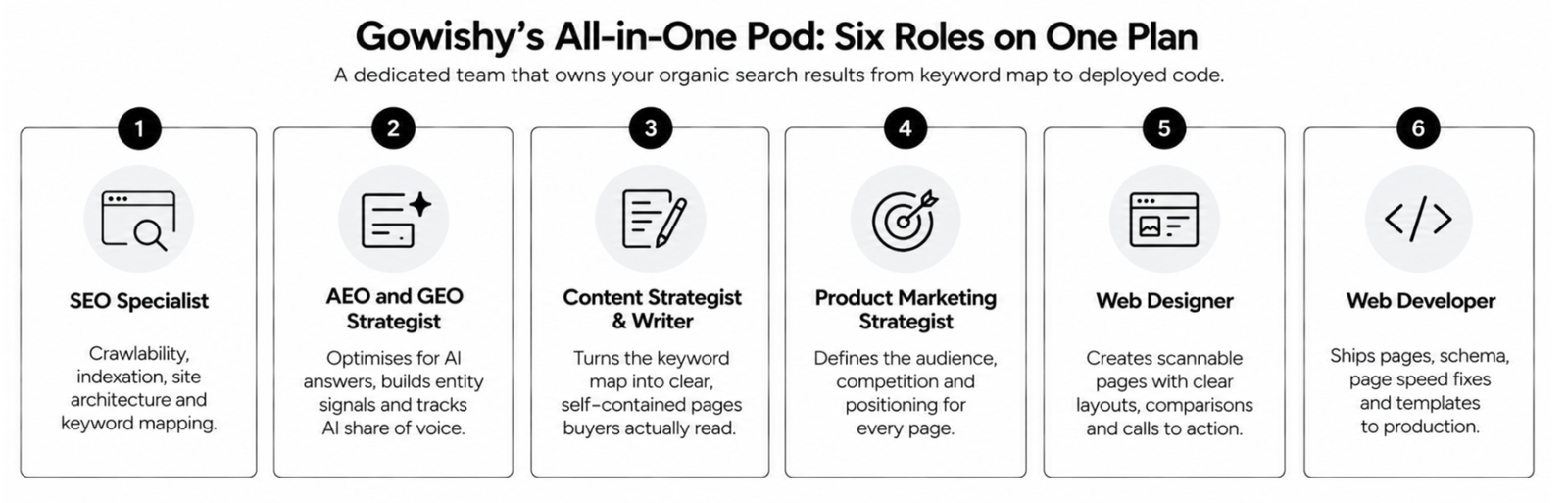
A pod is a small dedicated team that owns your organic search results from keyword map to deployed code. Gowishy’s pod has six roles, all working from one plan on one monthly fee, so the six-week chain from the intro shrinks to a conversation. Here are the six roles and what each one owns.
SEO Specialist
The SEO specialist owns the foundations: crawlability, indexation, site architecture, internal links, and the map of which keyword belongs to which page. On older B2B sites, a lot of this work is cleanup. Duplicate product pages, orphaned resource libraries, and redirect chains from three rebrands ago all quietly drain the authority your new pages need.
AEO and GEO Strategist
Answer engine optimization (AEO) structures content so tools like Google AI Overviews can lift a clear, direct answer from it. Generative engine optimization (GEO) builds the entity signals, third-party mentions, and citations that make an AI model name your brand when a buyer asks for options. This role tracks AI share of voice, meaning how often you’re cited for the prompts that matter to your pipeline.
Content Strategist & Writer
This role turns the keyword map into pages buyers actually read. In B2B, that means interviewing your product leads and sales engineers, since paraphrasing competitor blogs produces nothing worth citing. It also means writing in self-contained passages, because AI tools use retrieval-augmented generation (RAG), pulling short chunks of web content before they answer.
Product Marketing Strategist
Few SEO teams have one, and it shows. The product marketing strategist decides who each page is for, which alternative it’s competing against, and why your product wins that comparison. Without positioning, a page can rank on page one and still fail to persuade the finance lead who reads it.
Web Designer
The designer makes long technical pages scannable for a committee that skims. Comparison tables, pricing explainers, workflow diagrams, and clear calls to action live here, along with the layout decisions that decide whether a visitor scrolls or leaves.
Web Developer
The developer ships everything the other five decide. Schema deployments, page speed fixes, CMS templates and new page types go straight to production, without a ticket sitting in someone else’s sprint. This is the seat that would have turned that six-week “alternatives” page into a one-week job.
Six roles on paper is the easy part. What counts is what they build together, and on B2B sites that comes down to four kinds of work.
What an SEO Design and Development Agency Ships?
Design and development are where most SEO plans stall, so they’re also where an SEO design and development agency earns its fee. A strategy deck can’t fix a slow template or build a comparison page, but a pod with a designer and developer can. The following are the four builds that most often move B2B pipeline.
Bottom-of-Funnel Page Templates
Comparison, alternatives, integration, and industry pages convert because the reader is already deciding. Building them as reusable templates means the tenth page costs far less effort than the first, and every one inherits the same schema, internal links, and conversion path.
Interactive Components
ROI calculators, pricing estimators and side-by-side feature tables give a buying committee something to share internally. They also present facts in labelled, structured form, which is easier for both search engines and AI tools to extract than a paragraph buried in a PDF.
Core Web Vitals and Mobile Performance
Google’s Core Web Vitals guidance asks sites to load the main content within 2.5 seconds (LCP), respond to input in under 200 milliseconds (INP), and keep layout shift below 0.1 (CLS). Google says these, along with other page experience signals, align with what its core ranking systems seek to reward. B2B sites loaded with tag managers, chat widgets, and autoplay video heroes often miss all three.
Schema Markup and AI Readiness
Schema markup is structured code, usually JSON-LD, that labels what a page contains: your organization, product, FAQs, and reviews. Our guide to schema markup for AEO covers the types that matter most. Be wary of anyone selling secret AI tricks, though. Google’s own guidance on AI features says, “There are no additional requirements to appear in AI Overviews or AI Mode, nor other special optimizations necessary.” AI readiness rests on solid SEO plus being talked about elsewhere.
Put those four builds next to the way a traditional agency structures the same work, and the difference gets easy to see.
Traditional SEO Agency vs. the All-in-One Pod
Most traditional agencies are organized by department, which is how the six-week chain gets built in the first place. An all-in-one SEO and web agency in Toronto organizes around your site instead. The table below compares the two on the points B2B teams ask about most.
| Aspect | Traditional SEO agency | All-in-one pod |
| Primary metric | Rankings and traffic | Qualified pipeline and AI share of voice |
| Technical fixes | Audit report for your developers | Implemented directly on your site |
| Content | Volume blog posts | SME-informed pages built around positioning |
| Design and development | Not included, or a separate contract | In the team |
| Speed | Ticket queues across departments | One team, one plan, weekly shipping |
A pod isn’t the right answer for everyone, and it’s worth being honest about where it fits poorly. If you already have an in-house developer with spare sprint capacity and a strong content lead, a single SEO specialist may cover the gap. If you haven’t settled who your buyer is yet, fix positioning before you buy any search program. And a 50,000-page enterprise site with its own web team may need specialist consultants plugged into existing squads.
For most B2B companies between roughly 10 and 200 people, though, the fastest gain comes from cutting vendors rather than adding them. Fewer handoffs is the whole argument, and it shapes how Gowishy runs the work.
How Gowishy Works as a B2B SEO Agency in Toronto?
Everything above only works if the pod starts with the business rather than a keyword tool. Gowishy’s line for this is simple: “We do not start with keywords. We start with the business.” Here’s how that plays out over an engagement.
The work follows five steps.
- Understand covers your product, buyers, sales cycle, and current search footprint.
- Position settles who you’re for and which alternatives you’re up against.
- Map demand links the questions buyers ask, in Google and in AI tools, to the pages that should answer them.
- Build is where the designer and developer ship those pages, fixes, and components.
- Grow keeps the cycle running, with reporting tied to pipeline and AI share of voice rather than raw traffic.
So, back to the opening question. If one SEO fix on your site still needs four vendors and six weeks, the strategy isn’t the bottleneck. The org chart is. If you’d like to see what a single team would change first, talk to us at Gowishy.
Frequently Asked Questions
What makes a top B2B SEO agency in Toronto different from a general SEO agency?
A B2B SEO agency plans for long sales cycles, buying committees, and bottom-of-funnel searches like comparisons and alternatives. It measures success in qualified pipeline rather than traffic, works with your product and sales teams on content, and understands how Toronto-Waterloo tech buyers research vendors in both Google and AI tools.
What is an all-in-one SEO and web agency?
An all-in-one SEO and web agency combines SEO strategy, content, design, and web development in one team. Instead of sending audit reports to your developers, it builds and deploys the fixes itself. Gowishy’s version is a six-role pod working from one plan on one monthly fee.
How long does B2B SEO take to show results?
Technical fixes can show up in weeks once search engines recrawl your site. New content and authority building usually take several months, and B2B pipeline impact takes longer because sales cycles are long. Ask any agency what results to expect, in what timeframe, and how they’ll measure them.
Do B2B companies still need SEO if buyers use ChatGPT and AI Overviews?
Yes. Google says standard SEO best practices still apply to AI Overviews and AI Mode. AI tools also pull from pages that are crawlable, well-structured, and cited elsewhere. SEO builds that foundation, while AEO and GEO make your content easier to quote and your brand more likely to be named.
Is a pod more expensive than hiring an in-house SEO?
Not necessarily. An in-house hire brings salary, benefits, and tool costs, and still covers only one skill set. A pod spreads six roles across one monthly fee. The right comparison is the cost per shipped change, so ask each option how many fixes reach your live site every month.
Related articles
-

How Much Should a Toronto Small Business Actually Spend on GEO?
Most Toronto small businesses should expect GEO quotes somewhere between $1,500 and $5,000 CAD a month, with multi-location and highly competitive businesses going past $5,000. Treat those as typical market ranges, not a price list. We haven’t seen an independent, published survey of GEO pricing in Canada, so the figures in this guide are estimates…
-

5 AI Search Optimization Tips Toronto Businesses Can’t Ignore (AEO and GEO)
An awkward admission for an agency to make: there is no secret trick to getting your business named by ChatGPT or Google’s AI Overviews. Google says so itself. Its guidance for site owners states that “there are no additional requirements to appear in AI Overviews or AI Mode, nor other special optimizations necessary” (Google Search…
-
How to Master AEO and GEO for Small Business in Toronto: A Success Guide
The story in this guide is hypothetical. The clinic is invented, and so is everything that happens to it. Every step it takes, though, is a real part of AEO for small business in Toronto, and one you can start this month. Picture a two-location physiotherapy clinic, one on Queen Street East in Leslieville and…