


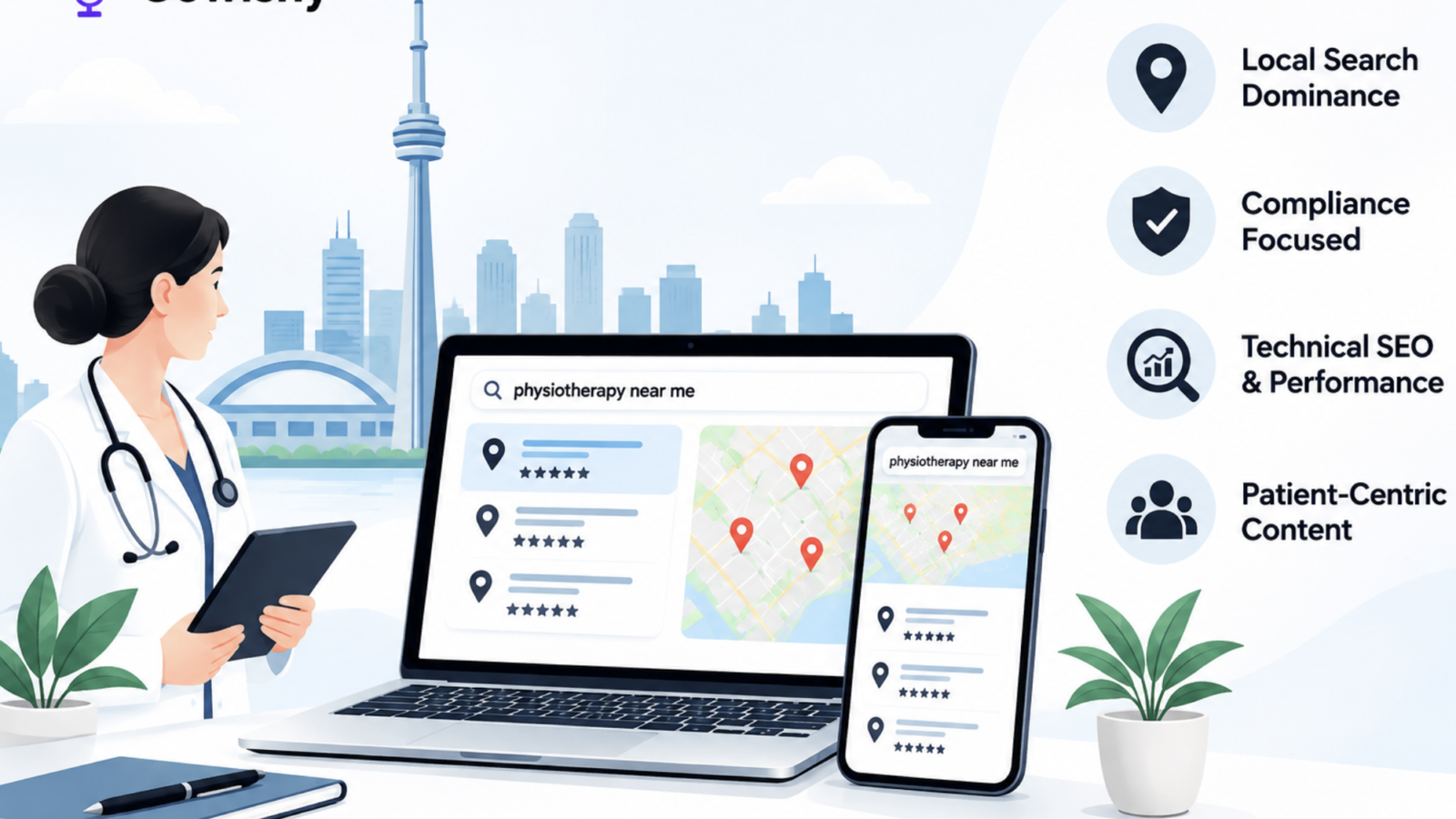
Healthcare SEO Agency in Toronto: Compliant Patient Acquisition & Local Search Dominance

“Physicians must not advertise in a manner which … contains any statement that promises or suggests a better or more effective service than any other physician or health professional.”
That line comes from the College of Physicians and Surgeons of Ontario’s Advertising policy, and it rules out a lot of what SEO agencies write by habit. The policy also covers advertising made “by or on behalf of a physician (i.e., by a third party).” When an agency puts “Toronto’s top dermatologist” on a clinic’s homepage, it’s the physician who answers for it.
This guide follows that one sentence through the whole job, right up to choosing an agency. It’s a marketer’s reading of published rules, not legal advice, so take specific questions to your college or a health lawyer.
The Healthcare Search Imperative: Balancing Patient Growth with Medical Compliance
Whose rules apply to this page? Ontario has no single health advertising code: each profession answers to its own college, privacy law sits on top, and Google applies its own standards to health content. We’d begin with the colleges, where the trouble usually starts.
Navigating Canadian Regulatory Colleges (CPSO, CNO, RCDSO)
Star widgets, “better than” comparisons, and brand-name treatment pages are the three most common collisions between agency habits and college rules.
CPSO policy bars testimonials, defined as “a statement endorsing the quality of a service, product or professional,” along with comparisons to other physicians and “any reference to a specific drug, appliance or equipment.” That last ban covers specific products whether they’re approved or not.
Its Advice to the Profession on advertising says a generic description (“I offer fillers”) may be allowed where a brand name isn’t. For dentists, the Royal College of Dental Surgeons of Ontario’s Practice Advisory on Professional Advertising counts websites as advertising and excludes testimonials, incentive programs, and “superlative or comparative terms,” naming “state of the art” and “cutting edge.” Any page that mentions a procedure must make clear whether the dentist is a general practitioner or a specialist.
Nurses are a different case. The College of Nurses of Ontario’s professional misconduct document has no advertising section like the CPSO’s, but it says “nurses must use only authorized terms, titles or designations,” and that qualifications can’t be misrepresented. Physiotherapists have an Advertising and Marketing Standard, in effect since May 1, 2025, that bars comparative statements about care providers.
Check the college for every discipline you offer.
What does a breach cost? We won’t predict that. Colleges enforce these rules through their complaints and discipline processes, and outcomes vary case by case. Plan on non-compliant copy coming down, and on the registrant named on it answering for it.
PIPEDA & PHI-Safe Patient Tracking
HIPAA, and its term “protected health information” (PHI), are American and don’t govern a Toronto clinic. Ontario’s Personal Health Information Protection Act (PHIPA) governs “personal health information” held by health information custodians, while PIPEDA is the federal private-sector law. The federal privacy commissioner lists PHIPA as substantially similar to PIPEDA, and which law applies is decided case by case.
Ontario’s Information and Privacy Commissioner says custodians need express consent to use personal health information for marketing, yet a conversion pixel on a booking page can send the URL and form fields to an ad or analytics platform, and if that URL reads /book/fertility-consult/, the platform has learned something about someone’s health. Google also asks that no personally identifiable information reach Analytics at all.
We found no commissioner guidance specific to tracking pixels.
Our advice is the cautious reading: count the booking, and leave out the reason for it. Keep services and conditions out of confirmation URLs, and have a privacy officer review every script on the booking page before launch.
You’ll lose some ad-reporting detail. You’ll still know which pages produce booked appointments.
E-E-A-T & Google YMYL (Your Money or Your Life) Standards
A persistent myth says Google’s quality raters reward clinician-reviewed pages. Google says E-E-A-T (experience, expertise, authoritativeness, and trust) “isn’t a specific ranking factor” and “Rater data is not used directly in our ranking algorithms.”
Nobody grades your pages by hand.
Its helpful content guidance still gives extra weight to E-E-A-T on “Your Money or Your Life” topics, those that “could significantly impact the health, financial stability, or safety of people.” On a clinical page, we’d want a named clinician author or reviewer whose credentials match the college register exactly, along with a “last reviewed” date that changes when the content does.
Who Answers for Agency-Written Copy
That opening quote settled this one. CPSO policy covers advertising made on a physician’s behalf by a third party, and the RCDSO advisory treats the website as the dentist’s advertising.
The agency drafts, and the registrant answers.
Ask for a written approval step and a record of who approved what, because an agency that claims to take compliance off your hands is promising something it can’t deliver.
The first place these rules get tested is the map.
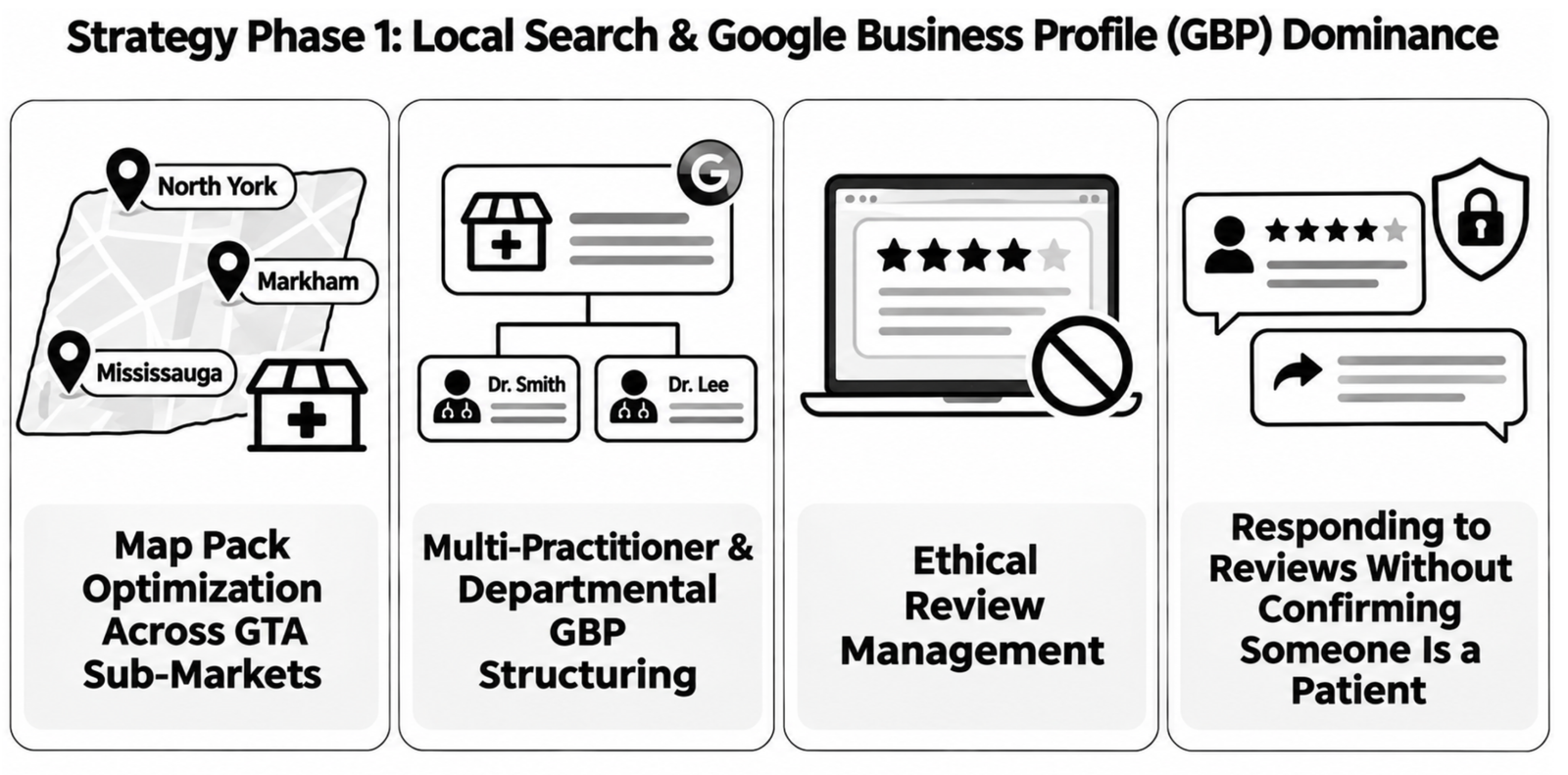
Strategy Phase 1: Local Search & Google Business Profile (GBP) Dominance
Local search is where the rules meet the patient’s next step: a call or a booking, often straight from the map. It’s also where review habits most often clash with college rules. The mechanics come first.
Map Pack Optimization Across GTA Sub-Markets
Google says local results are mainly based on relevance, distance, and prominence (the page also calls it popularity). Distance means a North York clinic rarely shows up for someone searching from Mississauga, which is why we’d treat each GTA city as a separate market. Our Toronto local SEO guide covers the basics. For clinics, pick the most specific primary category (“Physiotherapy clinic,” not “Medical clinic”) and give each location its own page.
None of this needs a superlative.
“Physiotherapy in Markham, open until 8 p.m., direct billing available” does more work than “Markham’s best physio,” and it won’t draw a complaint.
Multi-Practitioner & Departmental GBP Structuring
Google’s Business Profile guidelines name doctors and dentists as individual practitioners. Where several practise at one location, the organization gets its own profile, and each public-facing practitioner may have one titled with their name alone. A solo practitioner at a branded clinic should share one profile, named “[brand/company]: [practitioner name].”
Departments are harder. They qualify only if they operate as distinct entities, typically with a separate entrance, which a “laser suite” down the hall usually doesn’t have. Practitioner names should match the college register too, and under the CNO’s rules on titles that’s also a compliance point.
Ethical Review Management
The usual advice (“send an automated review request after every visit”) doesn’t survive contact with the CPSO.
Its advice says there’s no prohibition on sites where the public freely posts opinions. It also says a physician could potentially breach the testimonial ban by linking to reviews in advertising, directing patients to post, posting under other names, or paying to remove negative reviews. Google separately bans incentives and selectively soliciting positive reviews.
Here’s a view some agencies will dislike: for Ontario physician clinics, there’s no safe “ethical review request” to recommend. Turn off the automated email and take the star widget off the homepage.
The RCDSO advisory doesn’t address third-party review sites directly, but it excludes testimonials and offers advice on proposed advertising, so dentists should ask before starting any review program.
Responding to Reviews Without Confirming Someone Is a Patient
Under PHIPA, information that identifies a person and relates to the care they received is personal health information, and confirming that a reviewer is your patient, or correcting their account of a visit, can disclose exactly that. Keep replies short and general. Never mention a visit or a treatment. That’s our reading of PHIPA rather than commissioner guidance on reviews.
Have your privacy officer approve a template.
Once the profile is clean, the same facts start feeding AI answers.
Strategy Phase 2: Generative Engine Optimization (GEO) & AI Search Visibility
Some patients who once typed “clinic near me” now ask ChatGPT, Perplexity, or Gemini instead, and that brings back the CPSO question in a new form. If an AI tool calls a clinic “the best,” can the clinic say so? It can’t. Start with what can and can’t be promised.
Winning Recommendations in ChatGPT Search, Perplexity & Gemini
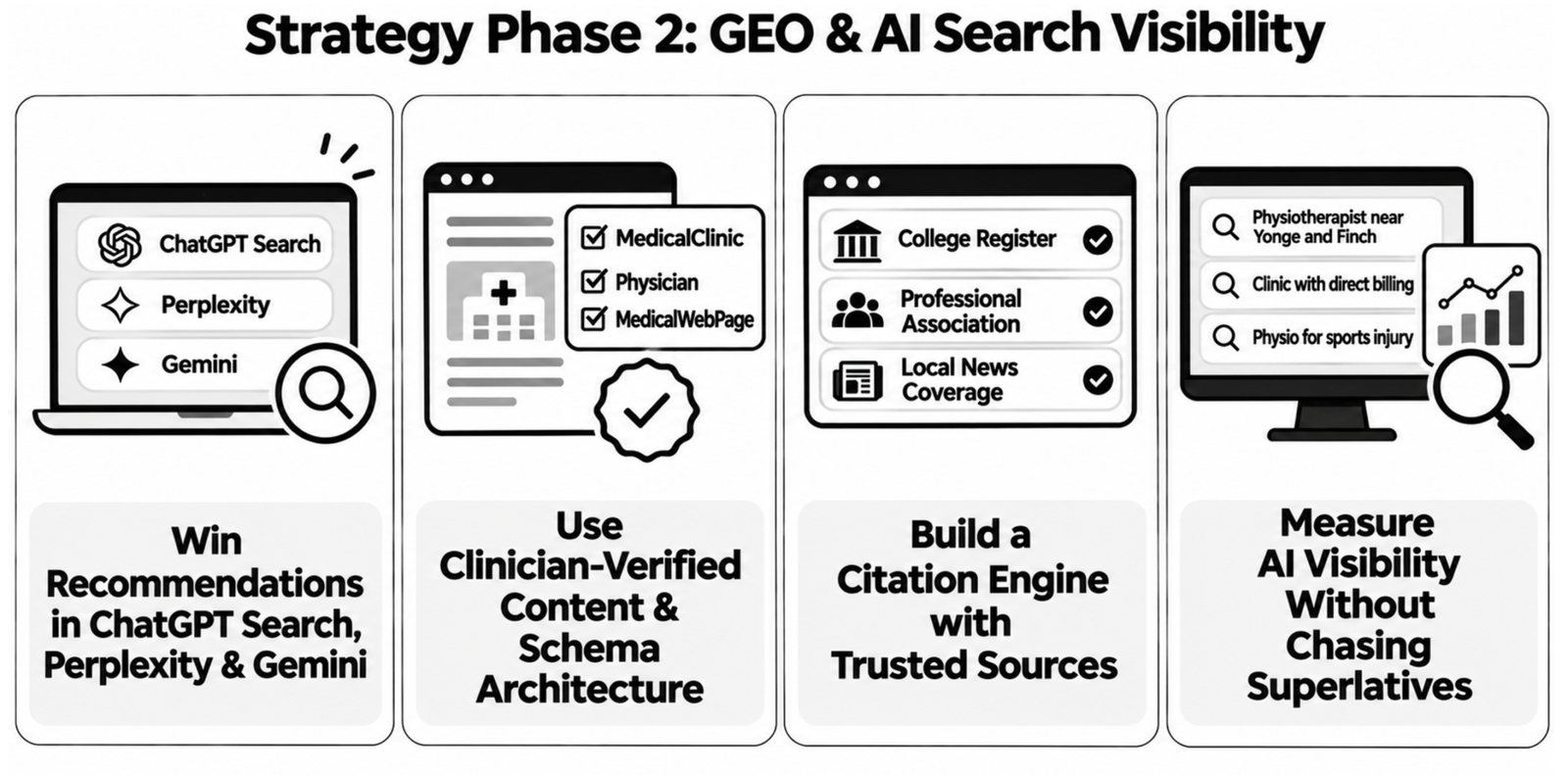
Generative engine optimization (GEO) builds the mentions and consistent facts that get a business named in AI answers, and answer engine optimization (AEO) writes pages so a tool can lift a clear answer. Nobody can promise that an AI engine will cite a practice as “the top recommendation.” Google says “There are no additional requirements to appear in AI Overviews or AI Mode,” and “There’s also no special schema.org structured data that you need to add.”
Many AI tools use retrieval-augmented generation (RAG), pulling documents in before answering, and plain pages do most of the work there.
Clinician-Verified Content & Schema Architecture
Schema is code that labels page facts for machines, and while it won’t buy a citation, it will keep your facts consistent. MedicalClinic, Physician, and MedicalWebPage all exist on schema.org, and MedicalWebPage inherits reviewedBy and lastReviewed. Since Google advises keeping structured data matching the visible text, the markup should never claim a reviewer the page doesn’t show.
A human-in-the-loop content workflow, with a clinician signing off every clinical page, is what makes reviewedBy true. It’s tedious. It also doubles as the approval record that protects the registrant.
Citation Engine & Third-Party Medical Authority
RateMDs sometimes gets called a “verified Canadian healthcare directory,” which is wrong. It’s a patient-review site and doesn’t verify credentials the way a register does, and under the CPSO’s advice on reviews, physicians shouldn’t link to it or send patients there. Each of those colleges publishes a public register, and your site’s names and specialties should match them word for word. After that, earn accurate association listings and real local news coverage.
Measuring AI Visibility Without Chasing Superlatives
Once a month, run a fixed set of patient-style prompts (“physiotherapist near Yonge and Finch that does direct billing”) and record whether your clinic is named and whether the facts are right. Our guide to the AI brand visibility audit sets out a method.
Being named only helps if the page loads.
Strategy Phase 3: Technical SEO & Speed for High-Converting Medical Sites
The patient who found you in an AI answer or the map pack usually arrives on a phone and meets a booking widget, and that’s where many clinic sites lose them. A fair amount of this phase is deleting things.
Eliminating Booking Widget & Script Lag
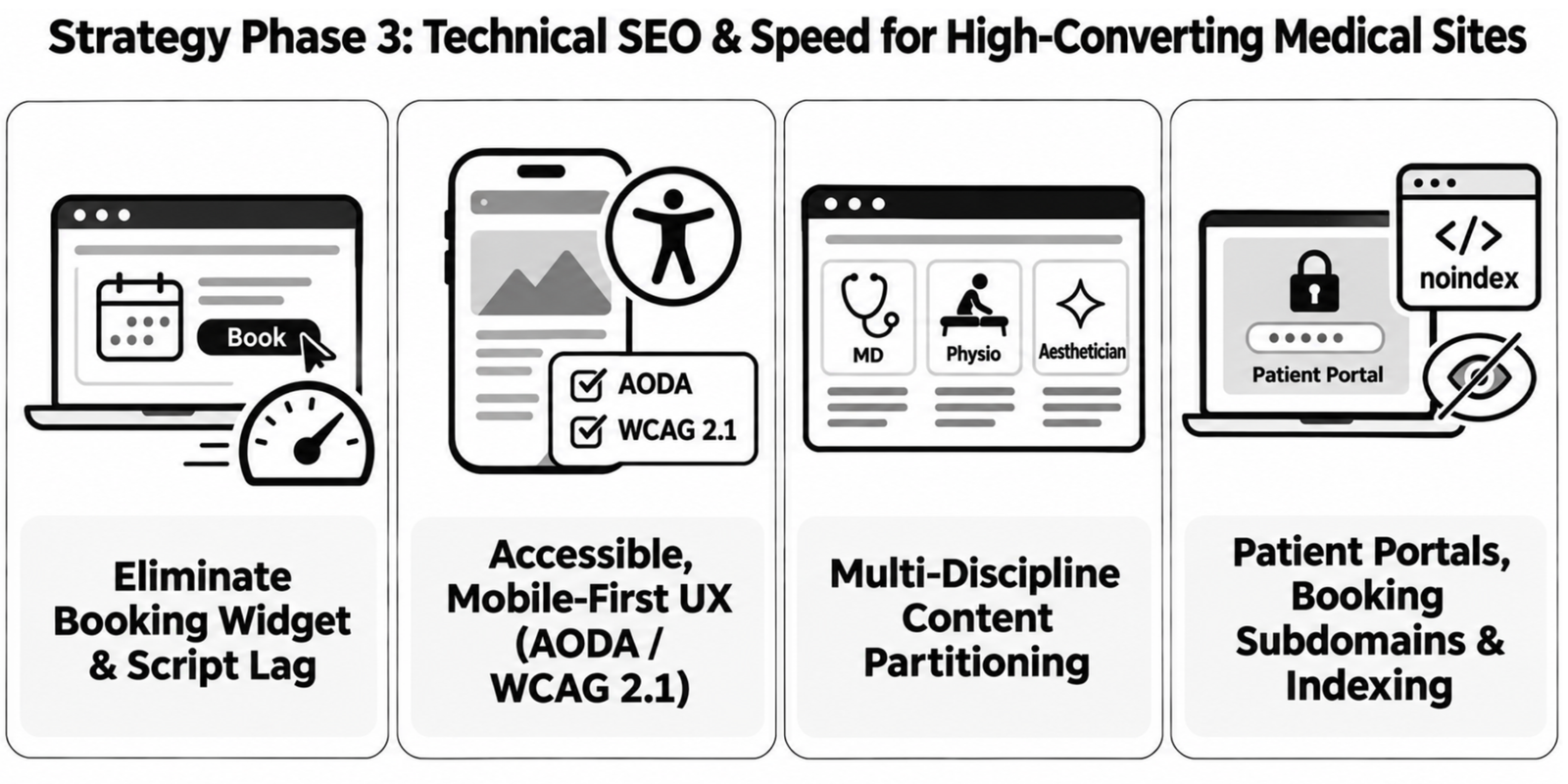
Google’s Core Web Vitals set three targets: Largest Contentful Paint within 2.5 seconds, Interaction to Next Paint under 200 milliseconds, and Cumulative Layout Shift under 0.1.
There’s no official “sub-second” requirement, and we’d be wary of anyone promising one.
Third-party booking and EMR or EHR scripts are common culprits, which is why we’d load the widget only when someone taps “Book” and remove any script nobody can explain, since old pixels slow pages and can leak data.
Accessible, Mobile-First UX (AODA / WCAG 2.1 Compliance)
That heading says WCAG 2.1, but the legal rule is narrower. Ontario’s AODA requires public websites to meet WCAG 2.0 Level AA (excluding live captions and pre-recorded audio descriptions), and only for designated public sector organizations and businesses or non-profits with 50 or more employees.
WCAG 2.1 AA is a sensible target, but the law doesn’t require it, and smaller clinics aren’t covered, though patients with disabilities are still your patients.
Multi-Discipline Content Partitioning
The CPSO says advertising for a multi-disciplinary practice can’t “provide or appear to provide any physician’s endorsement of services at the practice not provided by the physician.” A physician’s name shouldn’t sit on services the physician doesn’t provide. If an aesthetician does laser hair removal, the laser page shouldn’t feature the physician. (That example is our application of the CPSO provision, not its wording.) Give each service its own page naming who provides it and their profession, and keep the medical director’s photo off pages for services other staff deliver.
Patient Portals, Booking Subdomains, and Indexing
Portals and intake forms have no business in Google results. Google’s noindex documentation says the rule makes Google “drop that page entirely from Google Search results,” with a catch: if robots.txt blocks the page, “the crawler will never see the noindex rule.” Anything with patient information should also sit behind a login.
Those mechanics apply to every clinic. Content strategy doesn’t travel as well.
Specialty-Specific Healthcare Marketing Playbooks
Even inside Ontario the playbook shifts by discipline, each profession answering to a different college. An unregulated wellness business has none of these college rules. Privacy law and Google’s standards still apply. Dentistry and cosmetic surgery make the clearest place to begin.
Dental & Cosmetic Surgery SEO
Procedure guides do the heavy lifting. They just have to answer real questions without promising results.
Galleries need more care. The CPSO allows physicians to show before and after photos on a website, with express consent obtained after the service, de-identified images unless the patient consents to being identified, and a statement that results aren’t guaranteed. It doesn’t allow them where the public sees them unsolicited, which rules out display ads and social feeds. Dentists should read the RCDSO’s language on creating an “expectation of favourable results” first, and skip limited-time discounts, since the RCDSO excludes incentive programs.
Physiotherapy, Chiropractic & Rehab Networks
Two kinds of search drive most rehab bookings: neighbourhood searches (“physio near Leslieville”) and billing questions (“physiotherapy direct billing”). One “Locations” page with six addresses won’t compete in six neighbourhoods. Give each location a real page with its own practitioners and the insurers it bills directly. Chiropractors and other professions have standards this article doesn’t summarize.
Read them directly before making any comparative claim.
Specialized & Private Medical Clinics
Educational depth wins with buyers who research for longer. CPSO advice says educational content is more likely to be in good taste than “excessively commercial” content. Its policy also says physicians must not proactively contact people known to need medical services to solicit them, which rules out buying lists of people with a condition. We’d be cautious with remarketing audiences built from condition-specific pages too.
Medical Spas and Aesthetic Clinics
Ontario’s colleges regulate professionals, which means the rules on a med spa page depend on who provides each service. A physician-supervised injectables service brings in the CPSO policy, a nurse injector’s bio falls under the CNO’s rules on titles, and an aesthetician’s facial is outside both.
With the work defined, you can judge who’s able to deliver it.
Top 5 Healthcare SEO Agencies in Canada (2026/2027 Market Analysis)
Gowishy
Gowishy is a Toronto-based agency that runs a six-role pod on one monthly fee. Compliance sign-off stays with the registrant, which means you should judge the model against this article’s standards.
Ichelon Consulting Group
Ichelon describes itself as a healthcare-only marketing agency founded in 2018, with a doctor-reviewed editorial workflow. Its Toronto page says the work is “run from Gurgaon HQ” in India, and it also lists a Dallas office.
Wisevu
Wisevu is a Mississauga-based firm that says it has specialized in medical marketing since 2008, and it lists SEO and web design among its services for medical practices and dental clinics.
dNOVO Group
dNOVO Group is a digital marketing agency focused on professional services, with a Toronto office. It lists SEO and AI search optimization; its medical SEO and dental marketing pages sit alongside its legal practice.
Search Engine People
Search Engine People is a full-service agency with its main office in Toronto, founded in 2001 as an SEO firm, and its industry pages include digital marketing for dentists.
Red Flags When Hiring a Healthcare SEO Partner
Whichever firm you shortlist, we’d end the conversation over any of these:
- Review widgets or automated review requests pitched with no mention of college rules.
- Superlative copy (“best in Toronto,” “state of the art”) in sample pages or proposals.
- Generic writers on clinical pages, with no named clinician reviewer.
- “HIPAA compliant” tracking offered as if HIPAA applied in Ontario.
- Guarantees of rankings, AI citations, or compliance.
Fees tied to patient numbers deserve a separate look. The RCDSO warns against payments to a third party “that relate to the amount of business” a campaign brings in, and the CPSO bars taking part in coordinated efforts that direct people to a physician. Applying those to an SEO contract is our reading.
Have counsel check per-patient pricing.
Questions to Ask Every Agency on This List
Ask each firm, including us, which college rules would change your current copy and how clinical approval is recorded.
Good answers name the rules. It’s only fair that we go next.
The Gowishy Execution Advantage: Cross-Functional Pod Efficiency
Most of the failures above happen at handoffs. When three vendors own the schema, the copy, and the booking script, a superlative goes live before anyone has checked it. Gowishy runs one team for that reason, though it isn’t the right fit for everyone.
Zero Silos Between Developers, Medical Writers, and SEOs
The Gowishy healthcare SEO team puts developers, writers with medical subject experience, and SEO strategists in one pod. When a college rule means a treatment page needs new wording, the writer revises it, the developer updates the schema, and the strategist checks the links in the same cycle. Every clinical change still goes to your clinicians first.
True Bottom-of-Funnel ROI & Patient Attribution
Reporting centres on verified appointments and qualified calls by landing page and source, counted without condition data.
Patient lifetime value is harder, since it depends on patient-level records that belong in your practice management system. We report bookings by page and source, and your team applies an average value per new patient, calculated in your own systems, to estimate return.
How an Engagement Runs
Five steps shape the work: Understand, Position, Map demand, Build, and Grow. We start with your disciplines and colleges before anyone opens a keyword tool. We don’t guarantee compliance or rankings, and your clinicians approve what goes live under their names.
When a Pod Isn’t the Right Fit
A solo practitioner with one location who needs a clean Business Profile and a few accurate pages may get better value from a local specialist, while the pod earns its fee when several disciplines and locations have to move as one plan.
Go back to that CPSO sentence one last time. Any agency you speak to should be able to explain how it changes the copy on your site. If you’d like to test us on it, talk to us at Gowishy.
Frequently Asked Questions
How Do I Choose a Healthcare SEO Agency in Toronto?
Search “healthcare SEO agency Toronto” and most results will sound alike. A good healthcare SEO agency in Toronto will name the CPSO, RCDSO, or CNO rules that apply to you, report on booked appointments rather than traffic, and never guarantee rankings or compliance.
Can an Ontario Clinic Ask Patients for Google Reviews?
It depends on the profession. CPSO advice says directing patients to post on third-party sites could potentially breach the testimonial ban, so physician clinics should avoid review requests altogether. Dentists should ask the RCDSO first, and other professions should check their own college. Google bans incentives and selectively asking only happy patients.
How Should a Clinic With Several GTA Locations Handle Local SEO?
Treat each location as its own market. Someone researching “clinic local SEO GTA” should know that North York, Mississauga, and Markham each need an accurate Business Profile and a dedicated location page, with practitioner names that match the college register.
Does Medical Practice SEO Follow One Set of Rules Across Canada?
It doesn’t. Anyone selling “medical practice SEO Canada” as a single package is skipping a step: health professions are regulated province by province, so each province’s college rules need checking, not just Ontario’s. Privacy law varies too, and a network in Ontario and British Columbia needs copy reviewed against both provinces’ rules.
Can an Agency Guarantee Compliant Medical Digital Marketing?
No agency can. Colleges hold the registrant accountable, and the CPSO’s policy expressly covers advertising prepared by third parties. Compliant medical digital marketing comes from an agency that knows the published rules and records approvals, combined with your own clinicians’ review. If something’s unclear, ask your college before publishing.
Related articles
-
B2B SEO Agency in Toronto: Turning Organic Search into Qualified Sales Pipeline
Thirteen internal stakeholders and nine external influencers. That’s who shapes a typical B2B purchase, according to Forrester’s State of Business Buying 2026, and the count climbs for complex deals. That’s twenty-two people. Your monthly SEO report still leads with blog sessions. Marketing leaders start looking for a B2B SEO agency in Toronto the moment that…
-

Web Design & SEO Agency in Toronto: Building Search-First, High-Converting Digital Assets
This launch day is illustrative, not a client’s story. A Mississauga manufacturer goes live with a new website on a Tuesday. Leadership loves it, and someone orders lunch. Three weeks later, the marketing lead opens Search Console and watches the line slope down. The old service pages that brought in most quote requests now return…
-
How to Audit Your Website for AI Search Readiness: The Complete Checklist
On February 26, 2015, Google gave website owners a deadline. Starting April 21, it would expand its use of mobile-friendliness as a ranking signal, a change it said “will have a significant impact in our search results.” The industry nicknamed it Mobilegeddon. Businesses had about eight weeks, a free Mobile-Friendly Test, and a clear pass…