


B2B SEO Agency in Toronto: Turning Organic Search into Qualified Sales Pipeline

Thirteen internal stakeholders and nine external influencers. That’s who shapes a typical B2B purchase, according to Forrester’s State of Business Buying 2026, and the count climbs for complex deals.
That’s twenty-two people. Your monthly SEO report still leads with blog sessions.
Marketing leaders start looking for a B2B SEO agency in Toronto the moment that gap gets embarrassing, usually in a pipeline review where the head of sales asks which deals search helped create and the only answer on the screen is a line chart going up. This guide lays out a different build: keywords chosen by deal stage, pages written for specific committee members, technical work that holds up on enterprise architecture, and attribution that lands in the CRM.
The B2B SEO Misconception: Why B2C Playbooks Fail in B2B?
Consumer SEO has one good idea, which is that more visitors usually means more carts by Friday. Put a 22-person decision on top of it, and the idea falls over. This is because the reader is rarely the buyer and the signature may come a year after the first search. So start with the top line of any SEO report.
Vanity Traffic vs. Pipeline Revenue
Picture a hypothetical Vaughan packaging manufacturer whose most popular page is “what is corrugated cardboard,” with 100,000 visits a year from students and competitors. The plant manager almost never reads it.
She knows what corrugated cardboard is.
A page on food-grade corrugated packaging suppliers in Ontario might draw a few hundred visits. Some of those become quote requests from food processors in Brampton and Guelph. Guess which page gets the slide.
When a deal takes nine months to close, nobody can tell in month two whether content is working, and sessions fill the silence unless you score landing pages on qualified leads and opportunities instead.
Traffic can sit further down the report, as context.
The Multi-Stakeholder Buying Committee
Those 13 insiders don’t share one search habit, and the usual mistake is treating them as a single persona with a long job title. The sponsor asks whether the purchase pays back. The evaluator asks whether it will break something. A deal splits like this:
| Committee member | What they look for | Page that answers it |
| Executive sponsor | Business case, peer examples | ROI page with stated assumptions |
| Technical evaluator | Integrations, API limits, architecture | Integration and implementation docs |
| Finance | Pricing model, total cost | Pricing logic and cost breakdown |
| Procurement and security | Certifications, privacy terms | Trust centre |
| Daily users | “X vs Y,” workflow fit | Comparison and use-case pages |
Most B2B sites have the last row and nothing else. They then wonder why deals stall in security review.
You don’t need five versions of every page. An integration page can open with a two-sentence summary the sponsor can forward. Then move into specifics for the evaluator. And then finally close with licensing cost for finance.
So be honest about what the product doesn’t do. The engineer was going to find out anyway.
Long Sales Cycles & Attribution Gaps
A buyer reads your comparison page in March. Three demos and a procurement review later, she signs in November.
Most analytics setups lost that thread by April.
Fixing it is plumbing. Pass the first landing page and UTM values onto the contact record when someone fills in a form, then roll them up to the account and the deal. HubSpot’s Original Traffic Source property records a contact’s first known web source and now includes an AI Referrals value. Odoo can carry the same data through UTM fields on leads, and Salesforce through Campaign Influence. Then report at the account level, because the evaluator who found you on Google may never be the contact on the opportunity.
Will the data still have holes? Yes. Anonymous colleagues and chatbot-led buyers often show up as direct traffic, so add a “how did you hear about us” field and read the trend by quarter.
Where the B2C Playbook Still Helps?
Clean titles and fast templates carry over unchanged. Short-cycle products are the real exception: if you sell a $40-a-month tool that one person can buy on a credit card, broader content can pay off. Committee deals need a different keyword list.
Strategy Phase 1: High-Intent MOFU & BOFU Keyword Architecture
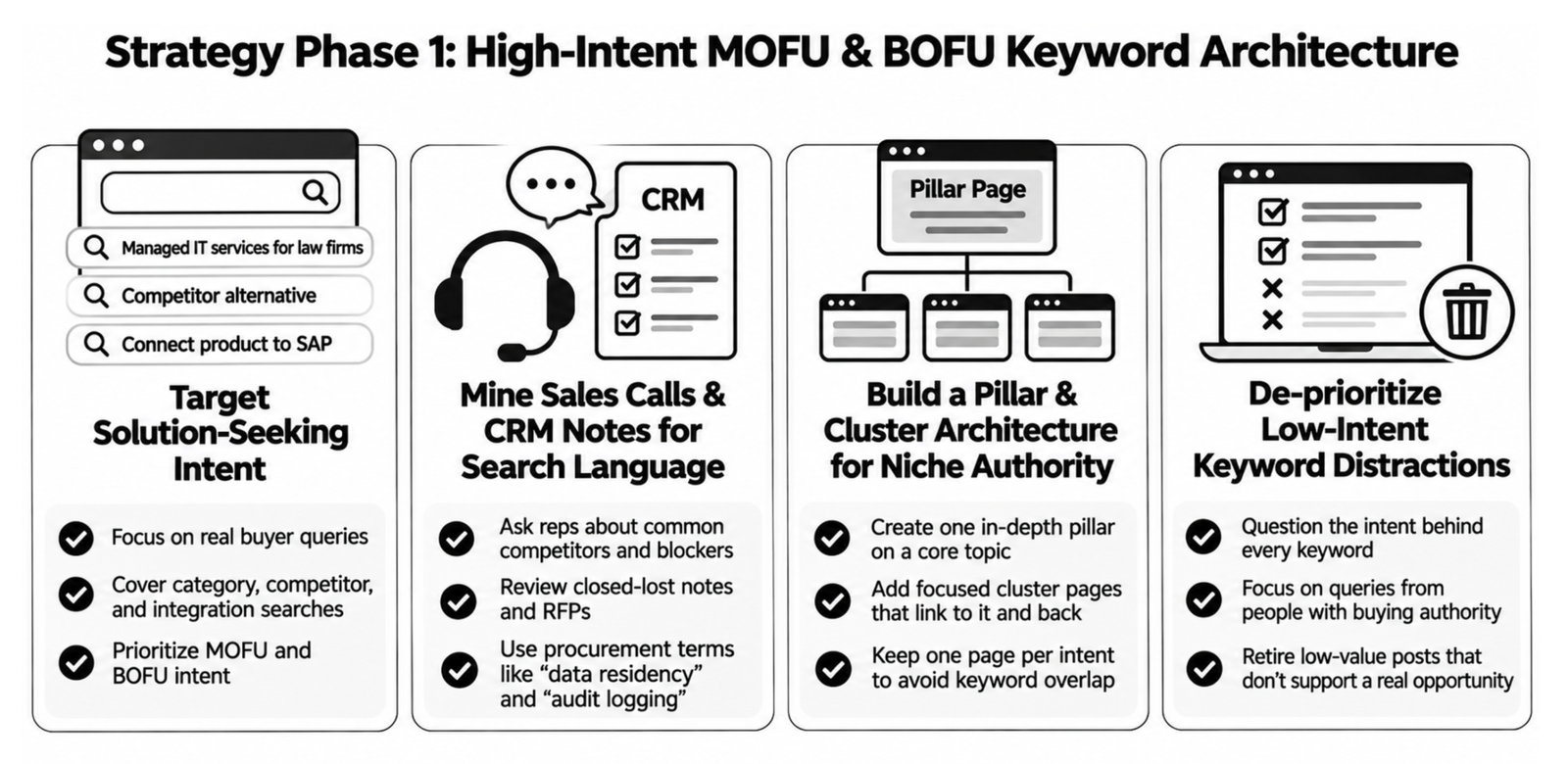
Accept that the committee is the audience and the volume column stops mattering much. A useful B2B organic search strategy starts from middle-of-funnel (MOFU) and bottom-of-funnel (BOFU) intent. This mans searches from people already evaluating options or close to picking one. We’ll end with what to throw away.
Targeting Solution-Seeking Intent
Keyword tools report 10 or 20 searches a month for many of the queries worth having, and none at all for some. Don’t panic. In B2B, one contract can be worth more than a year of consumer traffic. Buyers with a live problem search in three ways.
- Some name a category and a qualifier (“managed IT services for Ontario law firms”).
- Others name a vendor (“[competitor] alternative”).
- The third kind, which we’d build first, names a system the buyer already runs, like “connect [product] to SAP,” and it comes from the technical evaluator, who can quietly veto a deal if the answer isn’t on your site.
Mining Sales Calls and CRM Notes for Search Language
Your keyword tool has never joined a discovery call. Your reps have. Ask them which competitor gets named most often and which integration question comes up before a deal stalls. Then read the closed-lost notes. RFPs are tedious and worth it too. This is because procurement language (“data residency,” “audit logging”) often matches what the security reviewer typed into Google a week earlier.
Pillar & Cluster Architecture for B2B Niche Authority
Pillar pages have a bad reputation, mostly earned by very long guides nobody finishes. The structure itself is sound: one thorough page on a core topic, with narrower cluster pages linking to it and from it, which tells the technical evaluator you know the subject. A hypothetical Mississauga industrial automation firm would get more from one pillar on safety-rated control systems, with connected pages on retrofit costs and PLC integration, than from 30 surface-level articles on “the future of automation.”
Keep one page per intent, or your own pages end up fighting over the same query.
De-prioritizing Low-Intent Keyword Distractions
Now the unpopular part. We’d rather see a B2B company rank for 40 dull, expensive queries than 4,000 cheerful ones. Would a person with budget authority ever type this? If a student read the page, would you be happy about the visit? A no followed by a yes marks a distraction, and a good B2B organic search strategy says out loud which keywords it’s ignoring.
Retire old posts that never touch an opportunity.
The buying pages you keep have to work somewhere newer too, because part of the committee no longer starts at Google.
Strategy Phase 2: Generative Engine Optimization (GEO) & RAG for B2B Tech
Generative engine optimization (GEO) is the work of getting your brand named when AI tools answer a buying question, and answer engine optimization (AEO) is about making your content the passage those tools lift. Neither replaces keyword work. The same evaluators who search Google now also ask ChatGPT Search, Perplexity, and Gemini for vendor shortlists, which is where we’ll begin.
Capturing B2B Buying Queries on AI Search Engines
6sense’s 2025 Buyer Experience Report, based on more than 4,000 buyers, found that 94% of buying groups ranked preferred vendors before first contact, and that the pre-contact favourite wins 80% of deals. Your reps are often meeting a committee that has already decided.
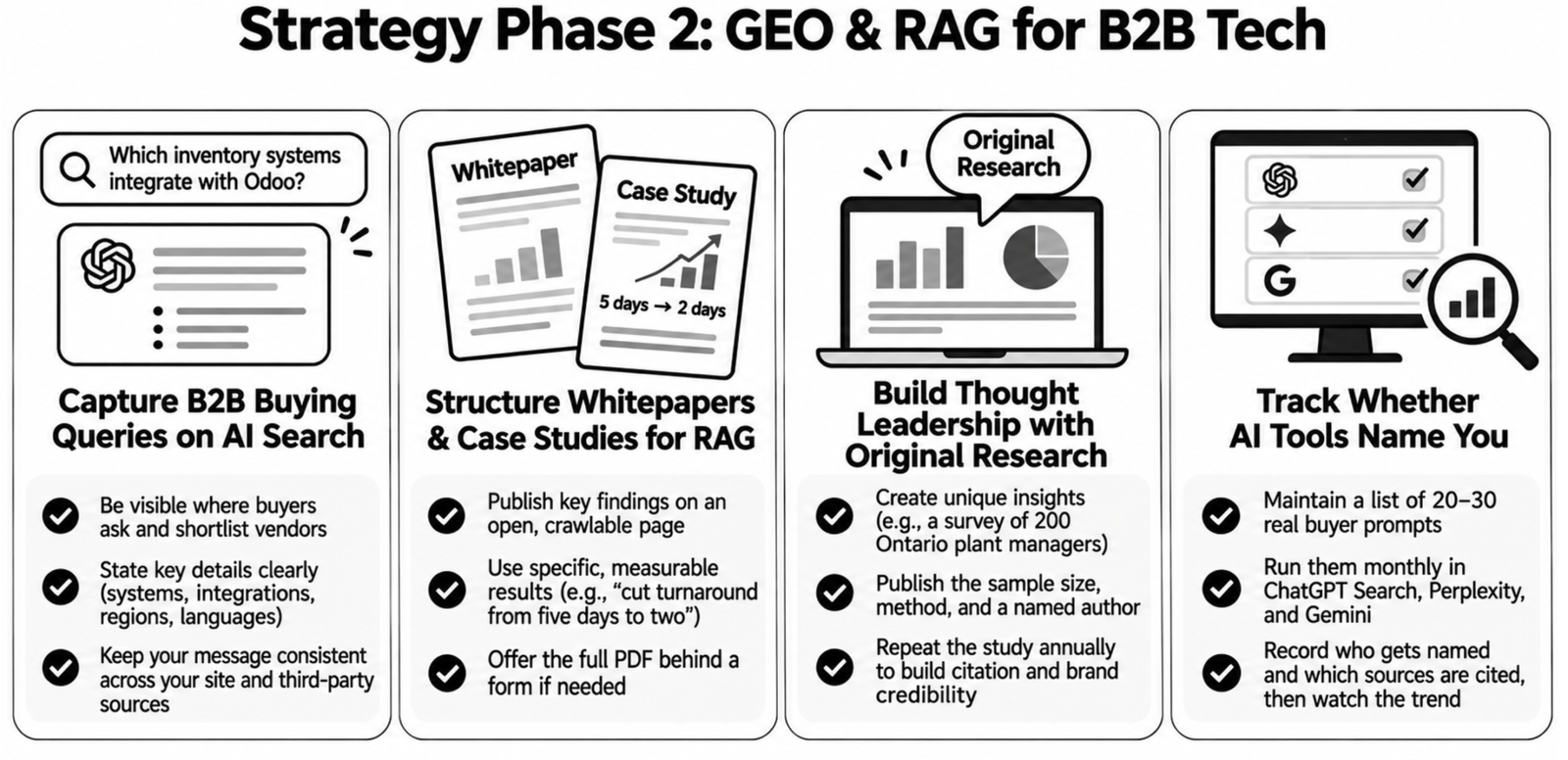
Some of that deciding happens in AI tools, where an evaluator might ask, “Which inventory systems for mid-sized Canadian manufacturers integrate with Odoo and support French?” To appear in that answer, your site has to say those things plainly on crawlable pages, and review sites and trade publications have to describe you the same way.
An agency that guarantees a citation is guessing.
Structuring Technical Whitepapers & Case Studies for RAG
A whitepaper locked behind a form gives an AI system nothing to read. Many of these tools use retrieval-augmented generation (RAG), retrieving passages from the web before composing an answer. You can keep the lead form: publish the key findings as an open HTML page with specific numbers, then offer the full PDF behind it.
In case studies, “improved efficiency” is invisible and “cut quote turnaround from five days to two” gets quoted, provided the result is real, and you have permission to publish it. Be honest about what JSON-LD (structured code that labels page facts) buys you. Google says there’s “no special schema.org structured data that you need to add” for its AI features, and no markup guarantees a citation.
Thought Leadership & Original Research Signals
Survey 200 Ontario plant managers about automation budgets and you’ve got a fact that exists nowhere else. Rewrite the top 10 search results, and you’ve got nothing, at some expense. Publish the sample size and method, put a named author on the report, and repeat the study every year until people cite the numbers by name.
An honest post from a senior engineer on why a common integration approach fails is thought leadership at a smaller scale, and no brochure can match it.
Tracking Whether AI Tools Name You
Without a measurement habit, GEO is guesswork with a nicer slide template. Write down 20 to 30 prompts your buyers would plausibly ask, run them monthly in those three tools, and record who gets named and which sources get cited. Answers vary, so read the trend.
All of which assumes your pages can be crawled at all. On large B2B sites, that’s rarely a given.
Strategy Phase 3: Technical SEO for Complex Enterprise Architectures
Run a docs portal and separate US and Canadian versions, and the assumption that crawlers can reach your pages fails quietly. We’d go looking for those failures before commissioning another word of content, starting with the estate itself.
Navigating Complex B2B Site Infrastructure
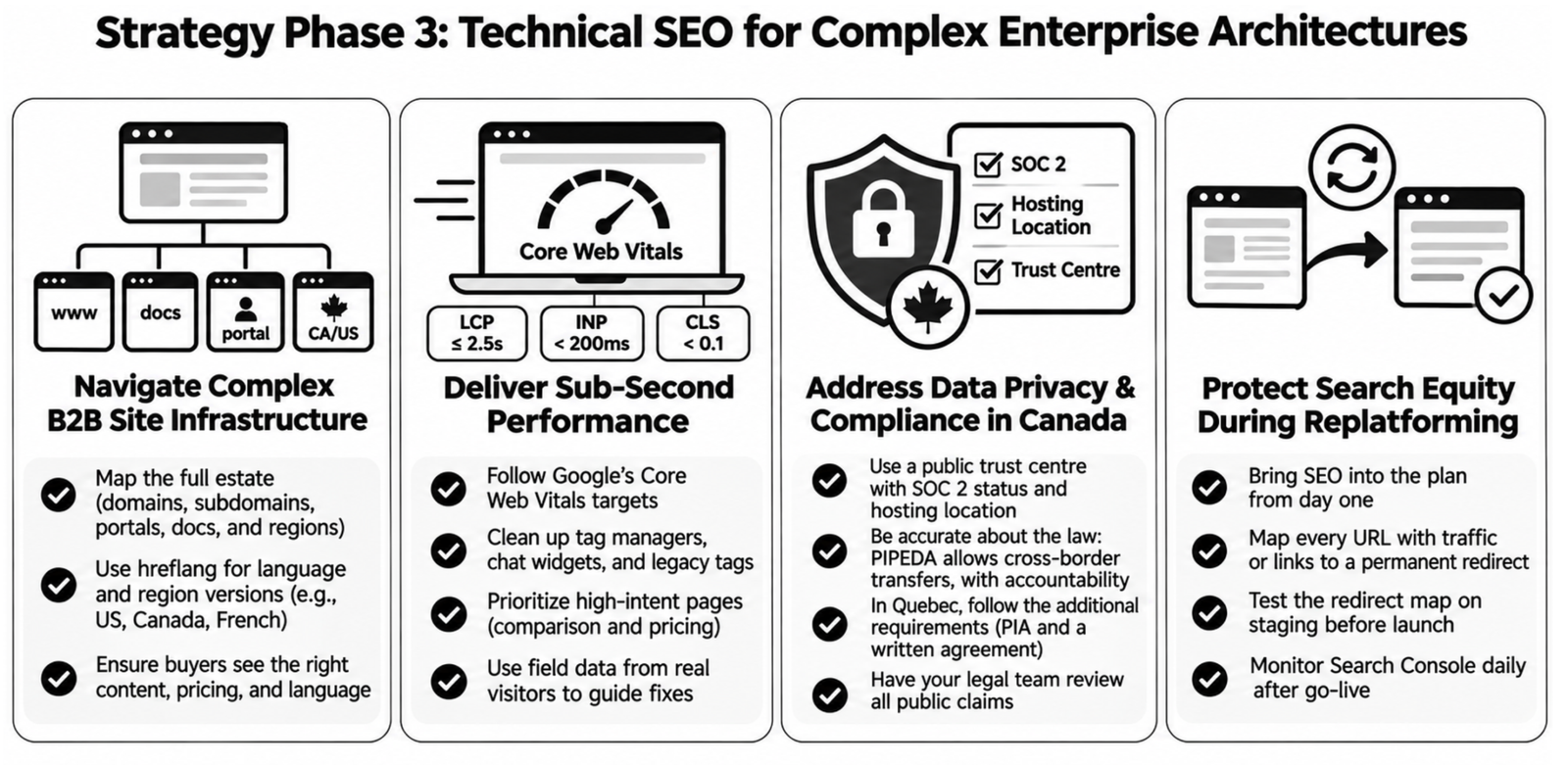
Map the whole estate before anyone touches a template, including every subdomain, customer portal, docs site, and regional version. Cross-border sites need hreflang annotations, code that tells Google which version of a page serves which language and region, and without them a Chicago buyer can land on your CAD pricing while a Montreal buyer never finds your French pages.
Sub-Second Performance for Decision-Makers
“Sub-second” isn’t a Google standard, whatever the heading says. Google’s Core Web Vitals guidance asks for the largest element to load within 2.5 seconds, interactions to respond in under 200 milliseconds, and a layout shift score under 0.1.
Enterprise builds miss these targets for boring reasons: years of tag managers and chat widgets, each added by a different team, with nobody owning the total. Fix your comparison and pricing templates first, using field data from real visitors.
A VP checking your pricing page on hotel Wi-Fi will not wait.
Data Privacy & Compliance Signals in Canada
You’ll hear advice to put privacy and compliance signals into technical metadata. We’d skip it. A security reviewer reads a page, so put the answers on one: a public trust centre with your SOC 2 status and hosting location.
Go carefully with the legal claims. PIPEDA, Canada’s federal private-sector privacy law, doesn’t prohibit transferring personal information abroad for processing, though the organization stays accountable for it. Quebec goes further: since September 2023, its private-sector law has required a privacy impact assessment and a written agreement before personal information is communicated outside the province, as McCarthy Tétrault summarizes. Don’t imply that federal law requires Canadian hosting. None of this is legal advice, and your counsel should approve the wording.
Protecting Search Equity During Replatforming
Most enterprise SEO damage happens during a migration, usually on a deadline somebody else set. Get SEO into the plan on day one, map every URL with traffic or links to a permanent redirect, test the map on staging, and watch Search Console daily after launch. A site that survives the move is one your reps can actually use.
Aligning SEO with Account-Based Marketing (ABM) & Sales Enablement
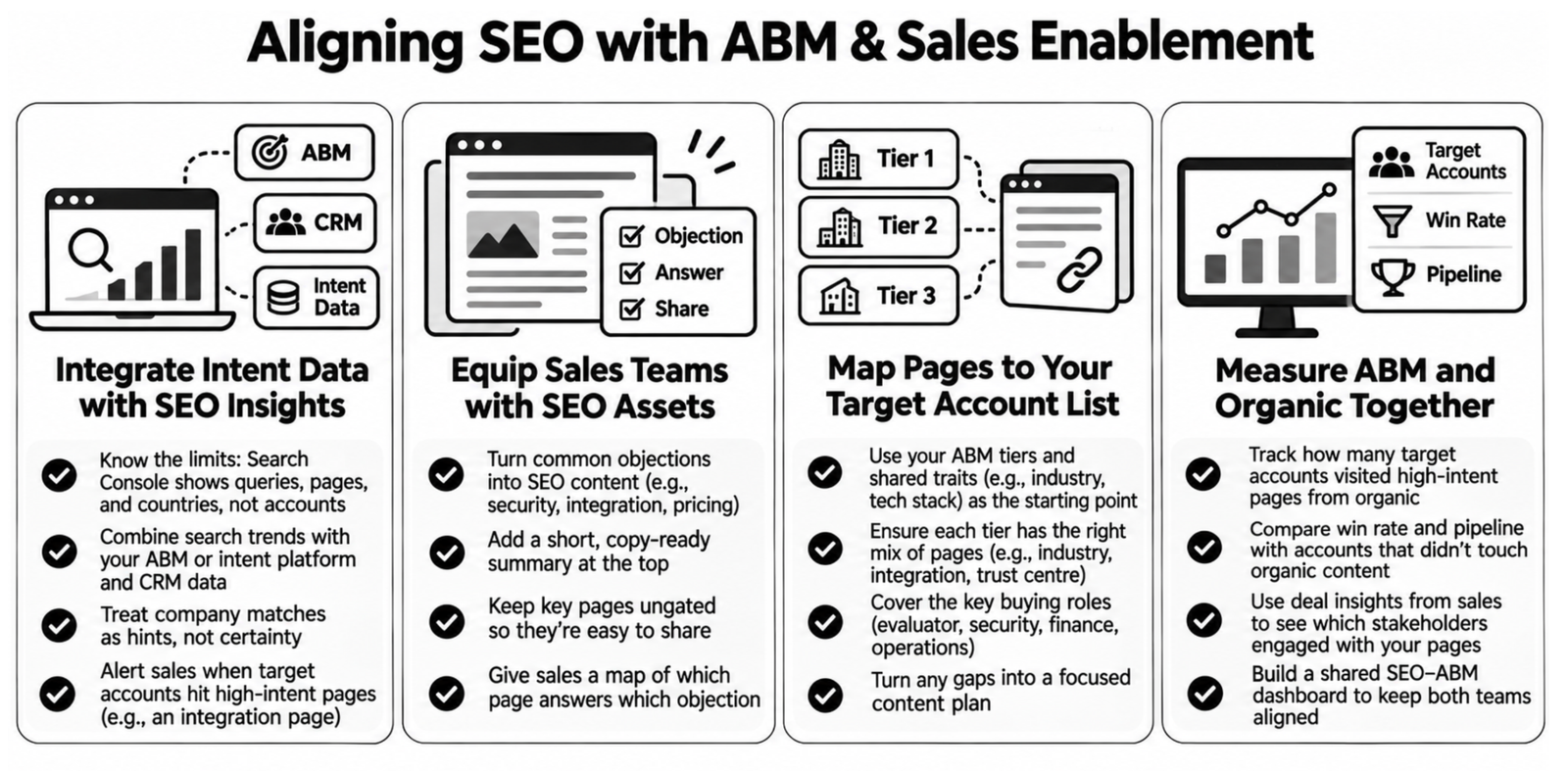
The trust centre your security reviewer reads is a sales asset that happens to rank. Account-based marketing (ABM) targets a named list of companies, and SEO either earns a place next to that list or runs beside it, ignored. Four habits connect the two, and the first needs a reality check.
Intent Data Integration
You’ll see it claimed that search analytics can identify target accounts. Google Search Console can’t do that. It shows queries, pages, and countries, and it will never tell you that a Bay Street insurer is researching your category. What it can show is which topics are rising, which gets useful once you pair it with your ABM or intent platform and CRM data on target accounts and treat company-level matches as hints. When three named accounts land on your integration page in the same month, sales should hear about it that week.
Equipping Sales Teams with SEO Assets
Ask a rep which objection cost them the last deal, then build the page that answers it, and you’ve got something reps will send that keeps earning search traffic between sends. Put a short summary at the top that a champion can paste into an internal email, and leave the gate off.
A page nobody can find at 4:45 on a Thursday might as well not exist, so hand sales a list of which page answers which objection.
Mapping Pages to Your Target Account List
ABM lists usually come in tiers that share an industry or tech stack, and the job is to lay your pages against those tiers and the committee roles from the earlier table. If tier one is Ontario food processors running SAP, do you have an industry page, an SAP integration page, and a trust centre their IT lead can read?
The gaps are your content plan.
Measuring ABM and Organic Together
How many target accounts visited a high-intent page from organic search this quarter? How did their win rate compare with accounts that never touched organic content? Twenty-two people shape each deal, and the reps usually know which of them have been reading.
So who’s going to build all this?
Top 5 B2B SEO Agencies in Canada (2026/2027 Market Analysis)
Some B2B companies can run everything above in-house. Many can’t. SEO and development usually sit in different teams, with RevOps somewhere else again. The firms below come at the committee problem in very different ways.
Gowishy
This Toronto agency runs a six-role pod on one monthly fee, covering SEO, AEO/GEO strategy, content, product marketing, design, and development. Judge it on its process and on the first call.
Thrive Internet Marketing Agency
Headquartered in Arlington, Texas, Thrive markets Toronto SEO services alongside enterprise SEO and PPC, which makes it a full-service option for companies that want SEO bought from the same firm as other channels.
WEB ROI
This Milton, Ontario digital marketing firm serves Oakville, Burlington, Hamilton, and the GTA. B2B and industrial are among its industries, which makes it a practical call for regional manufacturers and owner-led firms.
Productive Shop
Based in Toronto, this B2B marketing consultancy has an agency listing that describes enterprise share-of-voice projects and attribution modelling, and it’s worth a look if you want a B2B-only team that frames its work in pipeline terms.
Edkent Media
Established in 2014, this Toronto digital agency offers SEO, AEO, content, paid media, and CRM work, and B2B is one of the sectors it names.
How to Audit a B2B SEO Agency Proposal
Skip straight to the reporting section of any proposal, which tells you what the agency will actually try to improve. Then look for these red flags:
- Reporting on rankings and clicks, with no MQLs, SQLs, or opportunities.
- Any guarantee of a ranking position or an AI citation.
- A content calendar delivered before anyone has spoken to your sales team.
- No plan for who implements technical fixes.
Then ask each agency to walk you through how a single search visit becomes a field on a deal record in your CRM. Our guide to hiring an SEO agency without getting burned has more questions, and the same test applies to us.
Questions to Ask Every Agency on This List
The first call shows how an agency thinks. These work with any of the five firms:
- Which of our committee members would each planned page serve?
- Who on your team can change our templates, redirects, and hreflang?
- What would make you tell us we’re not ready for an agency yet?
Save the last one for the end. An agency that can’t name a reason to turn you down will say yes to anything.
The Gowishy Execution Model: Cross-Functional Pod Efficiency
Every section above ends up as work for several specialists at once, and handoffs are where quarters go to disappear. An integration page needs a strategist, a writer, a designer, and a developer, who in most setups work for different companies. Gowishy’s B2B SEO agency in Toronto practice keeps that work in one team, and the last part covers when we’d tell you to hold off.
Eliminating Agency-to-Dev Handoff Bottlenecks
Technical SEO sits with design and development in the six-role pod. An integration page or an hreflang fix doesn’t wait for another vendor’s sprint.
A recommendation that sits in a slide deck for two quarters has cost you money without changing your site.
Full-Funnel B2B ROI Tracking
Reporting connects Google Search Console, GA4, and your CRM, following organic-touched accounts through deal stages alongside pipeline and share-of-voice KPIs. Each monthly report opens on organic-touched opportunities and pipeline value, with AI visibility for your buying prompts beside them. Traffic and rankings come last, as supporting detail.
Working Alongside Your RevOps and Sales Leads
Attribution falls apart the moment marketing and sales disagree with RevOps about what counts as a qualified lead, which is why we work with your RevOps lead to settle those definitions before the first report. Of our five steps (Understand, Position, Map demand, Build, Grow), the first two are where we talk to your reps and read closed-lost notes, well before anyone chooses a keyword.
When to Fix Your CRM Before Hiring Anyone
If your CRM doesn’t record lead sources yet, or deals regularly skip stages, fix that before you hire any agency, us included. It’s usually a small job.
Twenty-two people will weigh in on your next deal, and most of them will never tell you what they read. If you want to know whether your site is speaking to them, talk to us at Gowishy.
Frequently Asked Questions
What Should I Look For When I Search “B2B SEO Agency Toronto”?
Expect specialists and full-service firms in the results, with directories thrown in. Shortlist anyone whose pitch is about pipeline and the CRM, then ask each one how a search visit becomes a field on a deal record. Vague answers to that question are your clearest warning sign.
Should I Hire a Canadian or a US-Based B2B SEO Agency?
Either can work if they understand your buyers, and a search for “B2B SEO agency Canada” will surface both kinds. A Canadian team will usually know PIPEDA, Quebec’s privacy rules, and CAD pricing without being told. A US firm may know American buyers better, which counts if most of your revenue comes from there.
When Do Enterprise B2B SEO Services Make Sense Over Standard SEO?
Enterprise B2B SEO services, GTA or anywhere else, earn their cost once you have several domains or regions, thousands of pages, a planned migration, or a committee sale with security review. A 40-page site selling to one decision-maker doesn’t need them. Ask whether implementation is in scope.
How Does a B2B Organic Search Strategy Support ABM?
ABM decides which companies matter. A B2B organic search strategy decides whether those companies find a useful answer from you when they look. Sales can then reuse those answers in outreach, and one asset ends up doing two jobs across a long deal.
How Long Before Organic Search Shows Up in B2B Pipeline?
It depends mostly on your sales cycle. Early signals, such as target accounts visiting high-intent pages, can show within a few months. With a nine-month cycle you’ll wait most of a year for closed revenue, so agree on the early signals upfront or someone will judge the program on sessions.
Related articles
-
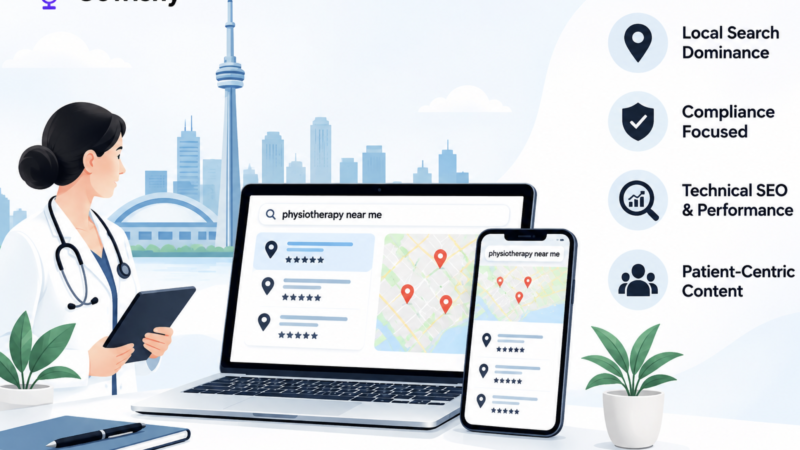
Healthcare SEO Agency in Toronto: Compliant Patient Acquisition & Local Search Dominance
“Physicians must not advertise in a manner which … contains any statement that promises or suggests a better or more effective service than any other physician or health professional.” That line comes from the College of Physicians and Surgeons of Ontario’s Advertising policy, and it rules out a lot of what SEO agencies write by…
-
Web Design & SEO Agency in Toronto: Building Search-First, High-Converting Digital Assets
This launch day is illustrative, not a client’s story. A Mississauga manufacturer goes live with a new website on a Tuesday. Leadership loves it, and someone orders lunch. Three weeks later, the marketing lead opens Search Console and watches the line slope down. The old service pages that brought in most quote requests now return…
-
How to Audit Your Website for AI Search Readiness: The Complete Checklist
On February 26, 2015, Google gave website owners a deadline. Starting April 21, it would expand its use of mobile-friendliness as a ranking signal, a change it said “will have a significant impact in our search results.” The industry nicknamed it Mobilegeddon. Businesses had about eight weeks, a free Mobile-Friendly Test, and a clear pass…