


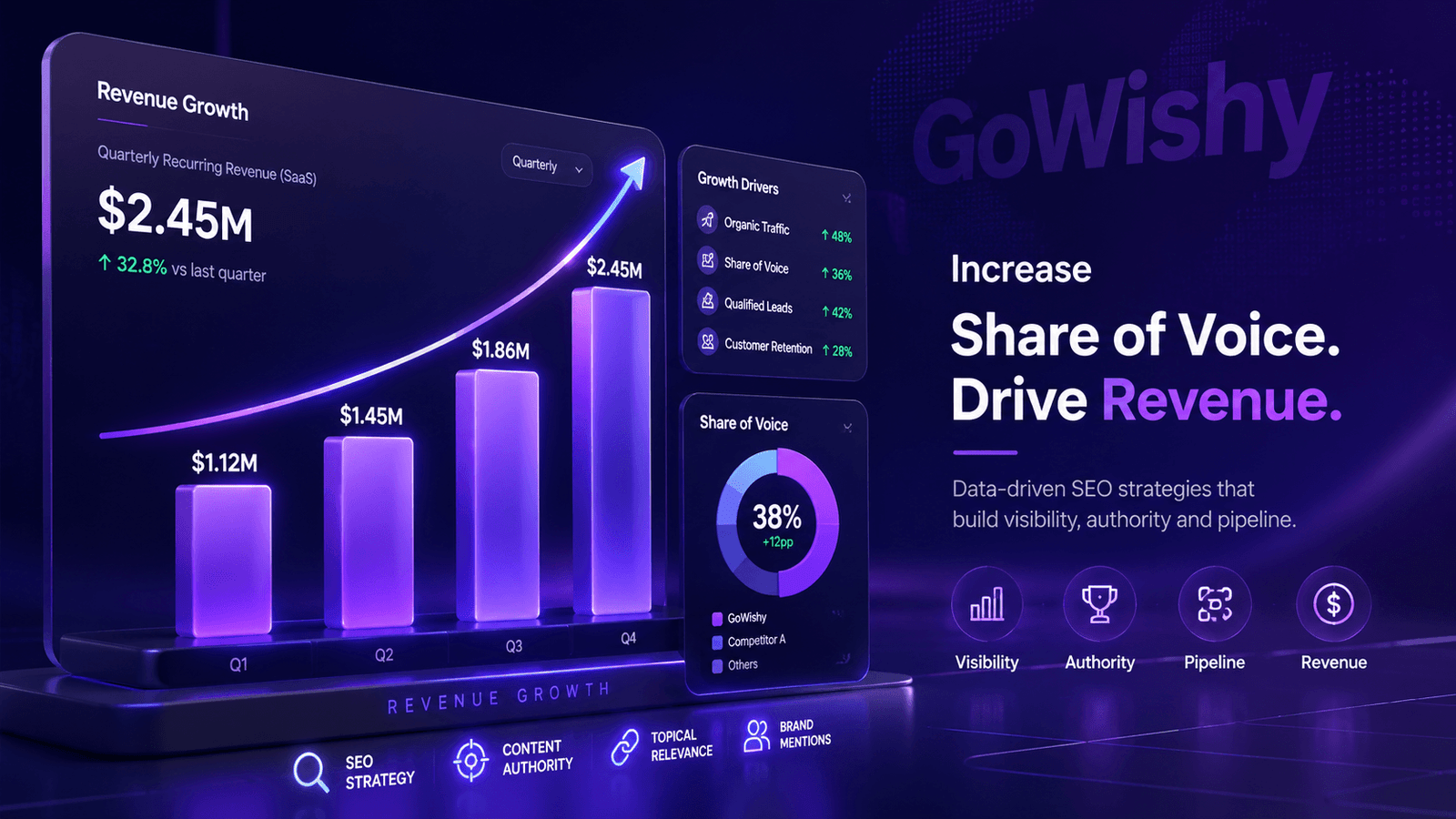
Beyond the Click: Why Modern SEO Strategy Demands a Pivot to Pipeline and Share of Voice

The playbook for evaluating organic search performance was pretty static for a while. You picked a set of keywords, published targeted content, built links, and watched the traffic climb. When traffic went up, everyone celebrated. When traffic went down, emergency meetings were called.
While driving traffic is a fundamental function of any SEO agency, treating page views and raw sessions as your primary metric doesn’t cut it anymore.. High search volume looks great on a monthly dashboard, but web traffic alone doesn’t pay the bills, close deals, or guarantee long-term brand dominance.
If your marketing strategy is still measured strictly by clicks, you are missing the bigger financial picture. Modern SEO marketing requires shifting focus away from vanity metrics toward business impact: Pipeline Influence and Brand Share of Voice.
Here is why this shift is essential for growing businesses, and how measuring these metrics transforms search from a cosmetic traffic generator into a core revenue driver.
The Flaw in Pure Traffic Metrics
Focusing exclusively on traffic creates a dangerous misalignment between search performance and real business outcomes.
It’s possible to double organic traffic, but the revenue doesn’t move at all. This happens when an SEO company prioritizes high-volume, top-of-funnel keywords that bring in readers who have zero intent to buy.
A blog post titled “What is cloud computing?” might bring in tens of thousands of visits, but if your company sells high-end enterprise IT architecture solutions, the vast majority of those visitors are students, researchers, or casual browsers.
When you optimize exclusively for clicks:
- Content becomes broad and generic to capture high search volumes.
- Leads generated from search tend to be low quality, straining sales teams.
- Executive leadership begins to question the true value of organic search investments.
Traffic is an indicator of interest, but pipeline is proof of value.
Metric 1: Pipeline Influence
Pipeline Influence measures how effectively your organic search content contributes to active sales opportunities and closed revenue.
Stop asking “How many people read this article?”
What you should be asking is “Did this article touch a prospect before they booked a demo or bought a product?”
How to Track Pipeline Influence
To measure search through a revenue lens, your SEO strategy must integrate directly with your CRM and analytics tools (like HubSpot or Salesforce). Look at key attribution models:
- First-Touch Attribution: Identifies which organic search entry point brought a user into your ecosystem for the very first time.
- Multi-Touch Attribution: Tracks all organic content a prospect interacted with throughout their multi-week or multi-month buyer journey.
- Organic Assisted Conversions: Highlights how blog posts, landing pages, and comparison guides supported a conversion, even if the user ultimately signed up via a direct visit or email later.
When you evaluate search by pipeline, content priorities change. You start creating deep-dive comparison pages, ROI calculators, detailed case studies, and feature breakdowns.
It’s not going to get the same numbers as the first, but the people who do visit are going to be more relevant to your product and fit closer to your ideal customer profile.
Metric 2: Brand “Share of Voice” (SOV)
While Pipeline Influence measures direct bottom-line impact, Brand Share of Voice measures market dominance. Organic Share of Voice tracks how visible your brand is in search engines compared to your top competitors for your most valuable commercial keywords.
In modern search, ranking number one for a single keyword is less important than dominating the overall digital real estate across an entire topic.
Why Search Share of Voice Matters
Search engines are changing, localized results, rich snippets, video embeds, and AI-driven answer engine overviews, the page 1 results of the top ten links are a thing of the past, and users are getting the answers they want from the AI overview the search engine provides, without even having to click to your page.
If a buyer searches for solutions in your industry, sees your brand mentioned across organic results, featured listings, and industry roundups, your perceived authority skyrockets. Even if they don’t click immediately, your brand becomes the top-of-mind choice when they are ready to purchase.
Tracking Organic Share of Voice allows an experienced SEO provider to:
- See where competitors are gaining ground before it impacts your bottom line.
- Identify high-value topic clusters where your brand is currently invisible.
- Evaluate true market visibility across hundreds of intent-driven search terms at once.
Bridging the Gap: How to Implement the Shift
Transitioning your leadership team or clients away from standard traffic reports requires clear communication and a gradual change in reporting frameworks.
1. Separate Traffic into Intent Buckets
All your traffic isn’t equal. Different people come to your links for different purposes.
- Informational: Broad, educational guides designed for brand awareness.
- Consideration: Solution-oriented guides, product comparisons, and evaluations.
- Transactional: High-intent product pages, demo requests, and pricing pages.
By evaluating conversion rates and pipeline contribution per bucket, you can show why high-intent pages deserve investment even if their traffic volume is modest.
2. Align Organic Search with Sales Enablement
Work with your sales team to understand the common questions, objections, and pain points prospects bring to sales calls. Build search content explicitly designed to answer those questions. When sales representatives use your search-optimized articles in their outreach emails, search content directly accelerates deals through the pipeline.
3. Redefine Strategic Success
Update your monthly reporting dashboards to lead with business metrics. Position pipeline generated, pipeline touched, and qualified leads at the top of the report. Put raw traffic data and individual keyword rankings near the bottom as supporting metrics.
Conclusion
Organic search remains one of the most cost-effective acquisition channels available to modern businesses. However, judging its performance strictly by clicks is an outdated practice that misrepresents its true value.
By shifting your key performance indicators toward Pipeline Influence and Share of Voice, you align search strategy directly with commercial growth. You move from simply getting found to actively closing deals and winning market share.
If you need assistance in transforming your search presence into a predictable revenue driver, talk to us at Gowishy, we’ll help you claim the market share your brand deserves.
Related articles
-

The Guide to Ranking in Google AI Overviews & LLMs
Google’s search results look a lot different than they did a few years ago. The first result isn’t a blue link that provides you with the most relevant result anymore. It’s an AI-generated summary of what you searched about. For Canadian businesses that have grown accustomed to the old strategies, this shift is a major…
-

Toronto’s Premier Answer Engine Optimization (AEO) Agency: Leading the Shift to AI-First Visibility
As Gen-AI transforms how people and companies discover information, traditional strategies are stepping aside to Answer Engine Optimization (AEO) and Generative Engine Optimization (GEO). If you have a brand and it isn’t being synthesized, recommended, and cited inside the latest tools like ChatGPT, Claude, Perplexity, and Google AI, you’re becoming invisible to a large part…
-
The Ultimate Buyer’s Guide: How to Hire an SEO Agency Without Getting Burned
When you hire an SEO agency, it should be a deliberate decision that creates a genuine opportunity for your business. But all too often, for most business owners, it ends up feeling like a gamble, with aggressive sales pitches, over-the-top promises that never materialize, vague promises of top rankings, and dense technical jargon designed to…