


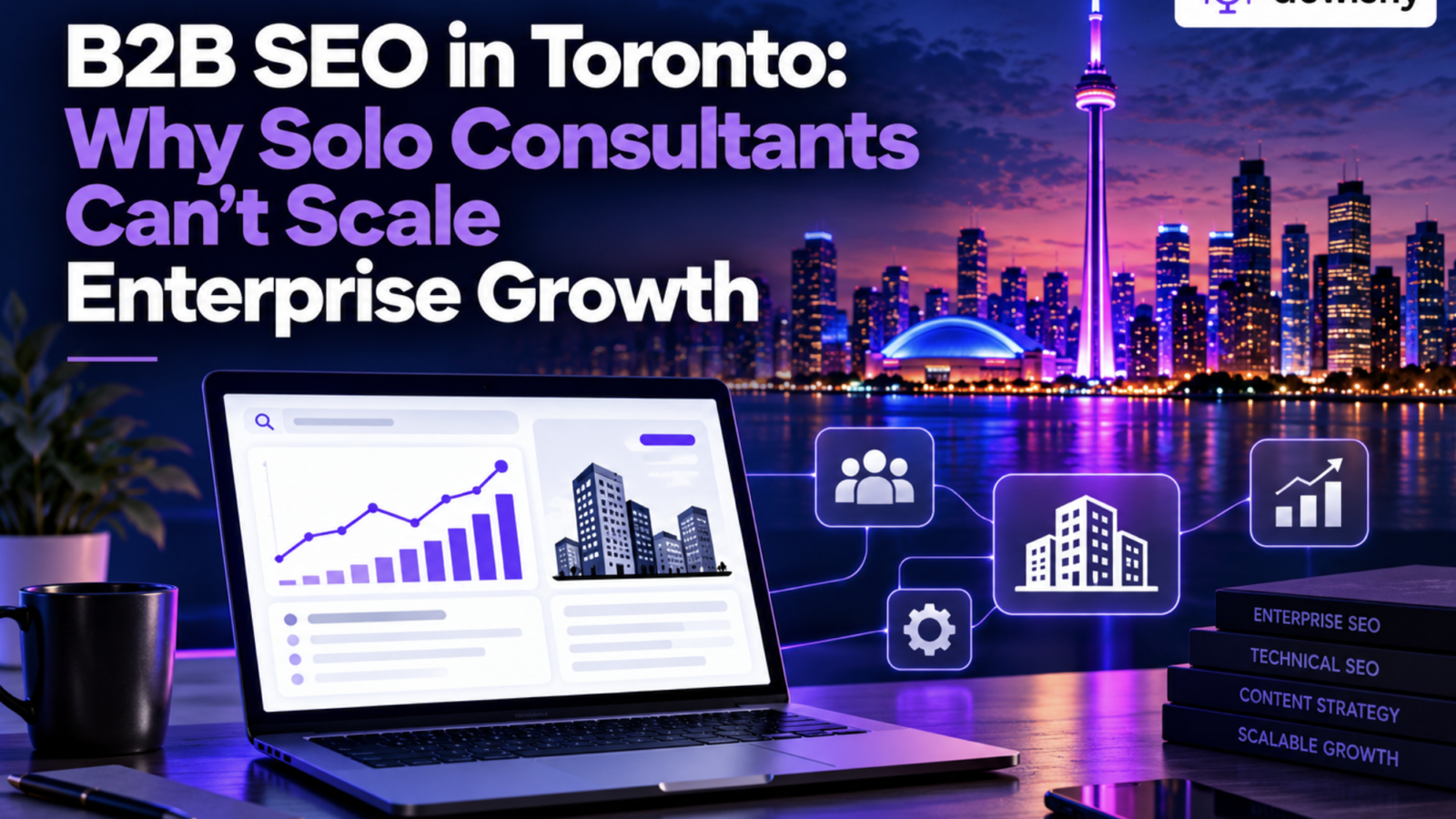
B2B SEO in Toronto: Why Solo Consultants Can’t Scale Enterprise Growth

If you’re redoing the kitchen in a Leslieville semi, hire the best independent contractor you can find. One skilled person who measures, builds, and installs everything is faster, cheaper, and more accountable than a firm. If you’re putting up a 30-storey tower on King West, that same person, however talented, can’t pour the concrete, wire the panels, run the plumbing, and pass inspections on schedule. You need a general contractor coordinating a crew.
Choosing between a solo consultant and a B2B SEO agency in Toronto works the same way. Plenty of companies are well served by one sharp consultant. The trouble starts when a B2B company with thousands of pages, a six-month sales cycle, and a buying committee expects one person to do the work of a crew.
This guide is for marketing leads at the point where that question gets real. It covers what makes B2B and enterprise SEO different, where solo capacity runs out, which skills the work actually needs, and how to tie it all back to pipeline.
The Anatomy of B2B and Enterprise SEO in the Greater Toronto Market
The kitchen-versus-tower comparison only holds if B2B search really is a bigger build than consumer search. It is, and the reasons have less to do with page count than with how B2B buyers behave. The following are the four differences that shape every enterprise SEO program in the GTA:
Long, Multi-Stage Funnels
A consumer looking for running shoes searches, compares, and buys in an afternoon. A procurement team buying payroll software, a cybersecurity audit, or a logistics platform can take months, and the research happens in stages: understanding the problem, exploring options, building requirements, shortlisting, and justifying the choice internally.
Each stage needs different content. A program that only targets “best [category] software” pages wins the shortlist stage and disappears everywhere else.
Buying Committees That Rarely Talk to You
B2B buyers do most of their homework alone. Gartner’s research on B2B buying found that buyers spend just 17% of their buying time meeting with potential suppliers, which means each of three competing vendors gets roughly 5%.
The rest of the time, they’re reading. For the SaaS firms in the Toronto-Waterloo corridor and the professional-services firms along Bay Street, your content is the sales rep in the room you’re not invited to.
Buyers Who Start With AI, Not Google
That reading increasingly starts in a chat window. G2’s 2026 survey of 1,076 B2B software buyers found that 51% now start their research with an AI chatbot more often than with Google, up from 29% a year earlier.
For an enterprise SEO program, that adds a second job: AEO (answer engine optimization) and GEO (generative engine optimization), the work of getting your company cited when ChatGPT, Perplexity, or Google’s AI Overviews answer a buyer’s question.
Why Generic Keyword Strategies Fail
Put those three together and the standard playbook breaks. Chasing high-volume terms brings in students and competitors. Enterprise buyers search in specifics: integration names, compliance requirements like SOC 2 or PIPEDA, “alternative to” queries, and pricing models.
A strategy built on those queries needs product knowledge, sales input, and technical execution at the same time. That’s where one person starts to run short.
The Capacity Bottleneck: Where Solo Consultants Hit Their Limits
None of this is about skill: some of the best SEO thinkers in Toronto work alone, and their audits are often sharper than an agency’s. The limit is hours and hands: a tower needs work on several floors at once, and one contractor can only stand on one.
Here are the four places the bottleneck shows up.

Technical Debt Across Thousands of Pages
Enterprise sites accumulate problems: duplicate parameter URLs, orphaned product pages, redirect chains from three CMS migrations ago. Google publishes a separate crawl budget guide for sites with 10,000+ pages that change daily, or a million-plus pages that change weekly. Then there’s the schema graph: Organization, Product, and FAQ markup connected consistently across every template. Diagnosing that is one job. Fixing it, template by template, is a much bigger one.
Content Velocity and Subject-Matter Access
Enterprise B2B content has to be credible to a CFO or a security lead. That means interviewing engineers, product managers, and customers, then turning those interviews into comparison pages, guides, and thought leadership on a steady schedule.
One consultant can do a few excellent pieces a month. A buying journey with a dozen stages and five personas needs far more than that.
Recommendations That Wait in Someone Else’s Queue
Most solo consultants deliver recommendations, and someone else implements them. At an enterprise company, that someone is a dev team with its own sprint priorities. A schema fix that takes an afternoon to build can sit in a ticket queue for a quarter. The consultant is right, and nothing changes.
The Single Point of Failure
When one person holds the strategy, the keyword research, the reporting, and the relationships, a vacation or a family crisis stalls everything. If they take a full-time role elsewhere, the institutional knowledge leaves with them.
Those four limits explain why capacity runs out. They don’t mean a consultant is the wrong hire, and the next section is honest about when one is the right one.
When a Solo Consultant Is Still the Right Call
The renovation analogy cuts both ways. Nobody hires a general contractor and a crew of twelve to redo a kitchen, and nobody should hire a full B2B marketing agency in Toronto for a job one expert can handle. Here’s when one expert is the better hire.
A consultant often makes more sense if your site has a few hundred pages, you have in-house developers who ship SEO tickets quickly, or you need a one-time technical audit or a strategy reset before hiring. Early-stage startups testing product-market fit usually fall in this group too. Spending on a full team before you know which buyers convert is premature.
The calculation changes when the build gets bigger. Once you’re past that stage, the question becomes which skills the work requires, and the list is longer than most job descriptions.
The Multi-Disciplinary Skills Enterprise B2B Growth Requires
Enterprise SEO is several professions sharing one goal. Each has its own tools, its own training, and its own way of being done badly. The table below lays out the roles and why they rarely live in one person.
| Discipline | What it covers | Why it’s hard to combine |
| Technical SEO | Crawling, indexing, site architecture, Core Web Vitals, schema | Needs developer-level fluency and time inside the codebase |
| Editorial strategy | Topic maps, SME interviews, writing, editing | Needs writing craft and steady production hours |
| AEO and GEO | Answer-ready passages, entity consistency, AI citation tracking | Changes month to month; needs dedicated attention |
| Digital PR and authority | Earned mentions, link acquisition, entity building | Relationship work that runs on outreach volume |
| Web design and development | Landing pages, comparison tools, CRO, CMS changes | Needs design and engineering skills, not just recommendations |
Someone who is excellent at the first row is rarely excellent at the fourth, and that’s fine. The problem is expecting it. Our post on building a human-in-the-loop content workflow shows how editorial and subject-matter input fit together on a single project.
Even a team with every skill covered can still fail one test, though. The work has to show up in the numbers your sales leader already watches.
Connecting SEO Output to Pipeline, Revenue, and CRM Data
Traffic reports don’t survive a budget meeting. If organic search can’t show up in the CRM as opportunities and revenue, it gets cut first when the quarter goes sideways. This section covers how enterprise programs make that connection.
The mechanics are unglamorous. Pass UTM and landing-page data into your CRM (HubSpot or Salesforce, usually) so each lead carries its first organic touch. Report on marketing-qualified leads (MQLs), sales-qualified opportunities, and closed revenue by content cluster, not just sessions by page. Add an AI-assistant option to “How did you hear about us?” because buyers who found you through ChatGPT often arrive as direct traffic. Our guide to pipeline and share-of-voice KPIs goes further on which metrics to report.
The other half is alignment with sales. Content should map to the accounts sales is chasing, which is where account-based marketing (ABM) and SEO meet. If your target accounts are Canadian banks, the pages they find should answer OSFI-related questions and name the integrations they use. Your sales team then reuses those same pages in follow-up emails.
This is the clearest example of crew work. It needs an analyst, a CRM admin, a writer, and someone who talks to sales every week.
Why Partnering With a Full-Scale B2B SEO Agency in Toronto Drives Real ROI
Back to the tower on King West. The general contractor earns their fee by getting the framers, electricians, and plumbers on site the same week, working from one plan, with one person accountable for the schedule. Nobody expects them to frame better than the carpenter. That’s the case for an agency, and here’s how we apply it.
Gowishy runs on a dedicated pod: an SEO Specialist, an AEO and GEO Strategist, a Content Strategist and Writer, a Product Marketing Strategist, a Web Designer, and a Web Developer, for one monthly investment. The developer in the pod ships the schema fix the same sprint the SEO Specialist finds it. The writer interviews your product team with the Product Marketing Strategist in the room. Nothing waits in another department’s queue.
Our process follows five steps: Understand, Position, Map demand, Build, Grow. We do not start with keywords. We start with the business, because enterprise SEO that ignores how you sell will chase the wrong searches. If you’re comparing options, our guide on how to choose a SaaS SEO agency lists the questions worth asking any firm, including us.
Hire the consultant for the kitchen. When you’re building the tower, talk to us at Gowishy.
Frequently Asked Questions
What does a B2B SEO agency in Toronto do differently from a consultant?
An agency brings several specialists at once: technical SEO, content, AEO and GEO, digital PR, design, and development. A consultant usually advises and relies on your team to implement. The difference matters most on large sites, where findings need to be fixed across many templates and pages at the same time.
When should a B2B company hire a solo SEO consultant?
A consultant is a strong choice for sites with a few hundred pages, companies with in-house developers who can implement quickly, one-time technical audits, or a strategy reset before you hire. Early-stage startups still testing which buyers convert often get better value from one expert than from a full team.
What is enterprise SEO?
Enterprise SEO is search optimization for large, complex websites, often with thousands of pages, multiple product lines, and several stakeholders approving changes. It covers technical health at scale, structured data across templates, content for long buying journeys, and reporting tied to CRM data, so organic results show up as pipeline and revenue.
How do you measure ROI from B2B SEO?
Connect organic landing-page and UTM data to your CRM, then report on qualified leads, opportunities, and closed revenue by content cluster. Track AI share of voice too, since many buyers now research in chatbots and arrive as direct traffic. Judge results over quarters, not weeks, because B2B sales cycles are long.
Does B2B SEO still matter if buyers use ChatGPT?
Yes. AI search tools pull from indexed web pages, so strong technical SEO and clear content remain the foundation. What changes is the format: answer-ready passages, consistent entity information, and third-party mentions all help an AI tool cite your company. A good B2B program handles traditional search and AI answers together.
Related articles
-

How Much Should a Toronto Small Business Actually Spend on GEO?
Most Toronto small businesses should expect GEO quotes somewhere between $1,500 and $5,000 CAD a month, with multi-location and highly competitive businesses going past $5,000. Treat those as typical market ranges, not a price list. We haven’t seen an independent, published survey of GEO pricing in Canada, so the figures in this guide are estimates…
-
5 AI Search Optimization Tips Toronto Businesses Can’t Ignore (AEO and GEO)
An awkward admission for an agency to make: there is no secret trick to getting your business named by ChatGPT or Google’s AI Overviews. Google says so itself. Its guidance for site owners states that “there are no additional requirements to appear in AI Overviews or AI Mode, nor other special optimizations necessary” (Google Search…
-
How to Master AEO and GEO for Small Business in Toronto: A Success Guide
The story in this guide is hypothetical. The clinic is invented, and so is everything that happens to it. Every step it takes, though, is a real part of AEO for small business in Toronto, and one you can start this month. Picture a two-location physiotherapy clinic, one on Queen Street East in Leslieville and…