



Automotive SEO for GTA Dealerships: Winning Google Maps & AI Search for Car Buyers

Picture a passenger in the slow crawl along the 401 near Yorkdale, phone in hand. They type: “Which dealers near Markham have a plug-in hybrid with winter tires, and does it still get the federal rebate?” The query is our own illustration, and it’s the test we’d put to any automotive SEO agency Toronto dealers are comparing.
Google might answer with a map pack and an AI summary. ChatGPT might name three stores. Either way, that passenger has a shortlist before opening a vehicle page.
Search engine optimization (SEO) used to mean ranking a website for “Toyota dealer Mississauga.” It now sits beside answer engine optimization (AEO), which structures facts so AI tools can lift them, and generative engine optimization (GEO), which builds the reputation that gets a business named.This guide follows our passenger from the highway to the showroom.
Auto Dealership SEO: Canada’s Car Buyers Have Outgrown the Template
The passenger’s question has three parts: inventory, a Canadian incentive, and a place. Most dealer websites answer the first one badly and ignore the other two. Here’s where the template falls short, starting with the feed.
Cookie-cutter inventory feeds are the usual culprit. A third-party provider pushes identical descriptions to every rooftop, stacks scripts on each page, and adds URL parameters that turn one car into dozens of addresses. Crawlers spend their visits on those duplicates while Tuesday’s trade-in waits.
Shoppers now ask in full sentences about trims, winter packages, and lease returns, and a spec table answers none of that. Our piece on how conversational search is changing keywords covers the wider shift.
Good auto dealership SEO, Canada-specific facts included, also has to keep up with rules that move. The federal iZEV program is closed. Its replacement, the Electric Vehicle Affordability Program, offers up to $5,000 on eligible new battery-electric vehicles and up to $2,500 on plug-in hybrids in 2026, with the battery-electric level falling to $4,000 in 2027. A $50,000 transaction cap applies unless the EV is Canadian-made, and only dealerships can submit the claim. Ontario has had no provincial purchase rebate since 2018, so any page still promising one is misleading a buyer before they’ve called.
Pricing has its own local twist. Ontario’s all-in price rule says an advertised price must include all fees and charges the dealer intends to collect, with only HST and licensing left out, and it names dealer websites and online marketplaces. A US template built around a low “internet price” plus fees doesn’t travel. French pages, meanwhile, matter more for a group with Ottawa or Quebec stores than for one in Vaughan. All of this assumes the page loads, which is the next problem.
Car Dealer Search Engine Optimization for High-Inventory Sites
Accurate rebate copy does nothing if the page never reaches the passenger. Car dealer search engine optimization starts with plumbing, because a lot with 400 vehicles can spit out thousands of URLs. Three fixes come first.
- Vehicle detail pages (VDPs) and search results pages (SRPs) create most of the mess. Give every vehicle one canonical URL, and keep filter combinations out of the index unless real demand exists. “Used hybrids in Mississauga” might earn a page. “Silver, 2019, under 80,000 km” won’t. When a car sells, send the visitor to similar stock instead of leaving a dead listing live.
- Mobile speed comes next. Google’s published “good” thresholds are a Largest Contentful Paint within 2.5 seconds, Interaction to Next Paint of 200 milliseconds or less, and Cumulative Layout Shift of 0.1 or less. Hit those on a mid-range phone first.
- Then there are the forms. Credit applications and trade-in tools collect financial details, which the federal privacy commissioner generally treats as sensitive under the Personal Information Protection and Electronic Documents Act (PIPEDA). Safeguards have to match that sensitivity, and you stay accountable for your vendors. PIPEDA doesn’t require Canadian data storage, whatever a sales deck implies. This isn’t legal advice, so ask your own counsel. Once the site can carry the traffic, the contest moves to the map.
Winning Local Search Packs Across the Greater Toronto Area
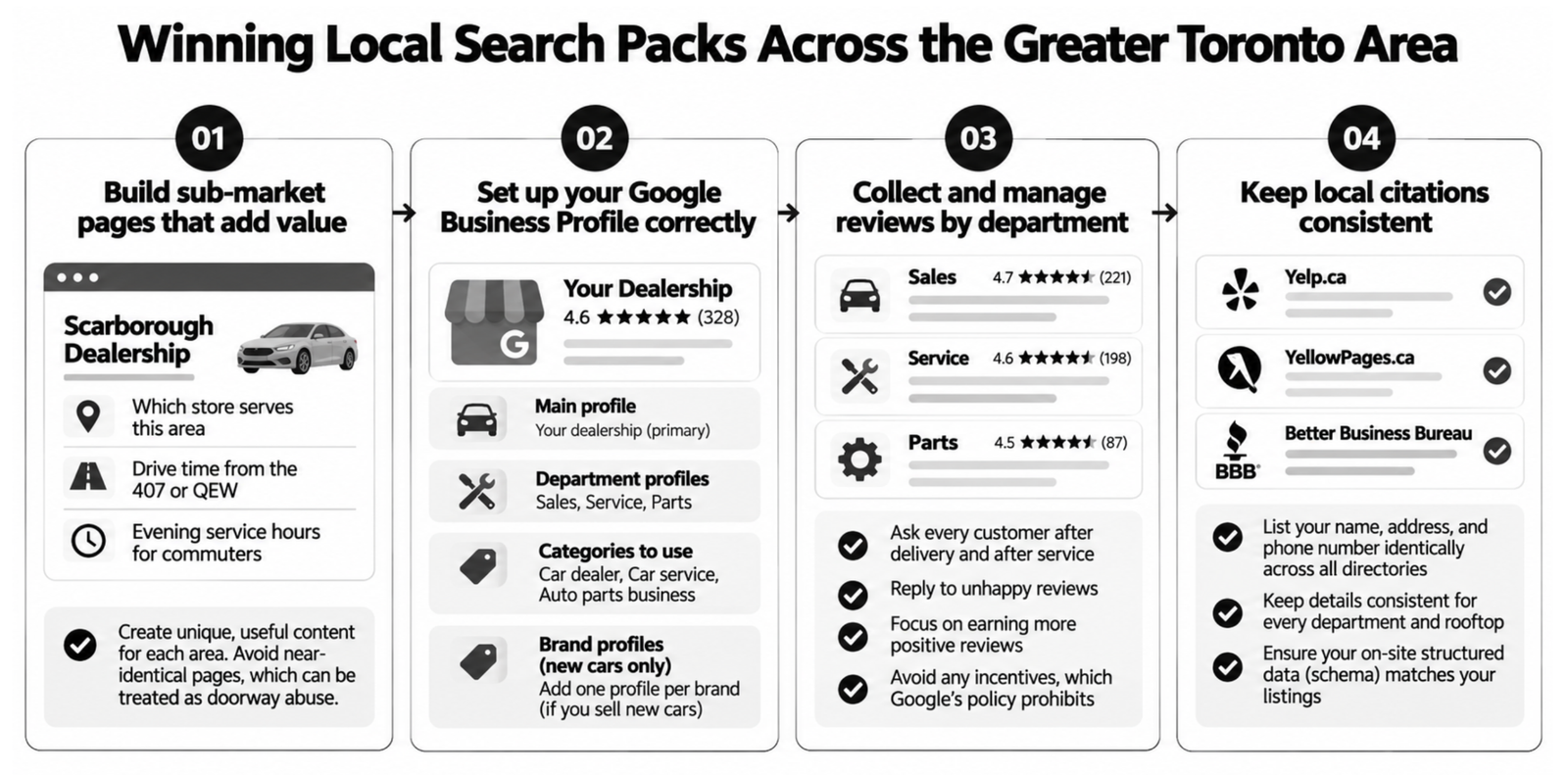
Our passenger’s query had a place in it, and Google says local results are “mainly based on relevance, distance, and popularity.” You can’t change where a store sits, so dealers compete on the other two. Here are the four places that work happens.
Sub-Market Pages With Something to Say
Pages for Scarborough, Brampton, and Oakville only help if each says something the others can’t: which store serves that area, the drive in from the 407 or the QEW, evening service hours for commuters. Google’s spam policies treat near-identical city pages funnelling users to one destination as doorway abuse.
Google Business Profile Structure
Google’s auto dealer guidance allows a main profile plus department profiles, named with the dealership and the department, and suggests the categories “Car dealer,” “Car service,” and “Auto parts business.” New-car dealers can add a profile per brand sold. Used-car dealers can’t. That page doesn’t list collision centres, so check before you create one.
Reviews by Department
Google says more reviews and positive ratings can help local ranking. Ask every customer after delivery and after service, reply to the unhappy ones, and skip incentives entirely: Google’s content policy prohibits them.
Local Citations That Match
Citations are listings of your name, address, and phone number on sites such as Yelp.ca, YellowPages.ca, and the Better Business Bureau. Keep them identical across every department and rooftop. Those listings describe you from the outside, and structured data does the same job on your own site, with less magic than vendors suggest.
Schema Markup for Dealers: AutoDealer, Vehicle, and Offer
Schema markup is code that labels facts so machines can read them without guessing. It’s also where dealer marketing gets oversold hardest. Here’s what still holds up.
Google removed its vehicle listing structured data documentation in September 2025 because the feature no longer appears in Search. FAQPage rich results stopped showing on May 7, 2026. Ask any automotive SEO agency Toronto dealers are interviewing what it expects from this markup, because anyone promising rich snippets from either is working from an old playbook.
The markup still has a job, though a smaller one. AutoDealer, a subtype of LocalBusiness in schema.org, pins down each store’s name, address, and hours. Vehicle and Offer state the VIN, trim, mileage, and price in a form any parser can read, and that price should match the all-in figure on the page. Pipe it all from your dealer management system so a sold car leaves the page and the markup at the same moment.
We’d implement it on every site and wouldn’t sell it as a ranking lever. Consistent, parseable facts are the whole benefit, and they matter most for the answer engines coming next.
An Automotive GEO Strategy GTA Buyers Can Actually Find
Clean data gets a dealership read. Getting recommended takes more. An automotive GEO strategy GTA dealers can run has three parts, and none of them is a secret trick.
Start with access. Tools like ChatGPT search and Perplexity use retrieval-augmented generation (RAG): they fetch pages, then write an answer from them. Our RAG explainer goes deeper. OpenAI’s crawler documentation says sites that opt out of OAI-SearchBot won’t be shown in ChatGPT search answers, so ask your website vendor what its firewall blocks. Google, meanwhile, states that “There are no additional requirements to appear in AI Overviews or AI Mode, nor other special optimizations necessary.”
Then write pages that answer the question. Lead with a direct 40-60 word answer on leasing versus financing for someone driving 25,000 km a year, on trim differences, on winter tire storage, and on the federal EV incentive. Date that last one, because the amount changes in 2027.
Finally, earn mentions you don’t control. Canadian auto media such as Driving.ca and Wheels.ca, regional news, and work with the Motor Vehicle Retailers of Ontario (the association formerly known as TADA) all give AI tools something to retrieve besides your own claims. A credible automotive GEO strategy GTA groups sign off on reports which prompts name each store, the way an AI brand visibility audit does. Nobody can promise the citation itself.
Multi-Location SEO for GTA Auto Groups
Everything so far multiplies when one company owns eight rooftops, and groups pick up a new way to lose: their own stores competing with each other. Two decisions prevent most of it.
Decide first what the group site owns and what each store owns. Check your manufacturer agreements first, since brand programs can dictate website vendors and page rules. Give store sites their inventory and service pages, and give one location the canonical version of any shared guide. Eight copies of one EV incentive article help nobody.
Then divide the map. If sister Honda stores in Mississauga and Oakville both target “Honda dealer Burlington,” they split signals. Assign each sub-market to one store, cross-link where territories meet, and review Search Console by rooftop each quarter. Territory gets the right store found, and then that store still has to earn the booking.
Turning Organic Visits Into Test Drive Appointments
Our passenger has now parked at the next exit and tapped a listing. Conversion rate optimization (CRO) decides what happens in the following thirty seconds. Here’s what we’d check on a phone first.
Put a tap-to-call button and a two-field test drive request on every VDP, and show whether the car is on the lot today. Use call tracking that keeps your main number on your Business Profile and citations.
Live chat is a judgment call. It catches shoppers while they’re interested, but a widget nobody answers at 4 p.m. on a Saturday is worse than a phone number. Staff it or cut it. Then feed calls, forms, and chats into your CRM to see which pages produced appointments. All this raises the question of who does the work.
Five Automotive SEO and Dealer Marketing Options in Canada (2026)
This is our own list, with Gowishy on it, so factor that in. There’s no ranking here, and two of the five aren’t SEO agencies, which we’ve flagged. Here’s what each does, based on its own materials.
1. Gowishy
A Toronto SEO, AEO, and GEO agency that works as a six-role pod on one monthly fee, covering strategy, content, design, and development together. Judge it on the plan it writes for your rooftops.
2. Leadbox
A Canadian dealer website and marketing company based in Mississauga. It says its WordPress-based sites are built only for auto dealers, and it sells websites, inventory tools, SEO, and advertising as one platform. It lists certifications with Stellantis and GM brands in Canada.
3. drivvn
An automotive e-commerce platform, and not an SEO agency. It provides B2C and B2B online storefronts, says 18 manufacturers are live on it, and shows logos including Volvo and Ford. Its focus is online retailing, with search left to other vendors.
4. Kijiji Autos and Dealer Solutions
A marketplace, and not an SEO agency. Dealers pay subscription packages to list inventory on Kijiji Autos and Kijiji, with dealer pages and premium placements. Useful reach, on Kijiji’s platform and separate from rankings on your own domain.
5. Convertus
A Vancouver-based dealer website and digital marketing vendor, acquired by TRADER Corporation in 2018 according to trade listings, which describe custom sites plus SEO and paid search services. Confirm its current offering directly.
How Gowishy Works as an Automotive SEO Agency Toronto Dealers Can Audit
Every section above crossed disciplines: feeds touch development, profiles touch operations, answer content touches writing. We think the vendor split costs dealers more than any single bad tactic. Here’s how we set it up instead.
As an automotive SEO agency Toronto groups can bring in alongside their OEM website program, we put one pod on one monthly investment: an SEO Specialist, an AEO and GEO Strategist, a Content Strategist & Writer, a Product Marketing Strategist, a Web Designer, and a Web Developer. Where your platform allows it, the team that spots a duplicate VDP problem can ship the fix. Our process runs Understand, Position, Map demand, Build, and Grow, because “We do not start with keywords. We start with the business.”
We report on qualified leads, calls, and booked appointments ahead of clicks, and we can’t guarantee rankings or AI citations. A single used-car lot that needs its Business Profile cleaned up doesn’t need us, and a local specialist will cost less.
If you run several rooftops, go back to the passenger on the 401 and search their question yourself this week. If your stores aren’t in the answer, or the answer is wrong, talk to us at Gowishy.
Frequently Asked Questions
What Should an Automotive SEO Agency Toronto Dealers Hire Fix First?
Start with indexation and accuracy. Check for duplicate VDP URLs, sold vehicles left live, outdated EV incentive claims, and prices that break Ontario’s all-in rule. Then clean up Business Profile structure across departments. Those fixes cost little compared with new content, and later work depends on them.
Does Vehicle Schema Still Produce Rich Results in Google?
Don’t plan on it. Google removed its vehicle listing structured data documentation in September 2025 because the feature no longer appears in Search. Vehicle and Offer markup can still state your inventory facts clearly for any system reading the page, so treat it as data hygiene.
Should Every Dealership Department Have Its Own Google Business Profile?
Often, yes. Google allows department profiles for dealerships, named with the dealership and department, and suggests separate categories for sales, service, and parts. New-car dealers can also have a profile per brand, while used-car dealers can’t. Follow the current guidance closely, since rule-breaking profiles can be marked as duplicates.
How Long Does Car Dealer Search Engine Optimization Take to Show Results?
Technical and profile fixes can show up within weeks of Google recrawling the pages. Content and third-party mentions usually take several months. Any auto dealership SEO Canada vendor offering a fixed date for a top ranking is promising something no one controls, so ask for milestones.
Related articles
-

Healthcare SEO Agency in Toronto: Compliant Patient Acquisition & Local Search Dominance
“Physicians must not advertise in a manner which … contains any statement that promises or suggests a better or more effective service than any other physician or health professional.” That line comes from the College of Physicians and Surgeons of Ontario’s Advertising policy, and it rules out a lot of what SEO agencies write by…
-

B2B SEO Agency in Toronto: Turning Organic Search into Qualified Sales Pipeline
Thirteen internal stakeholders and nine external influencers. That’s who shapes a typical B2B purchase, according to Forrester’s State of Business Buying 2026, and the count climbs for complex deals. That’s twenty-two people. Your monthly SEO report still leads with blog sessions. Marketing leaders start looking for a B2B SEO agency in Toronto the moment that…
-

Web Design & SEO Agency in Toronto: Building Search-First, High-Converting Digital Assets
This launch day is illustrative, not a client’s story. A Mississauga manufacturer goes live with a new website on a Tuesday. Leadership loves it, and someone orders lunch. Three weeks later, the marketing lead opens Search Console and watches the line slope down. The old service pages that brought in most quote requests now return…