


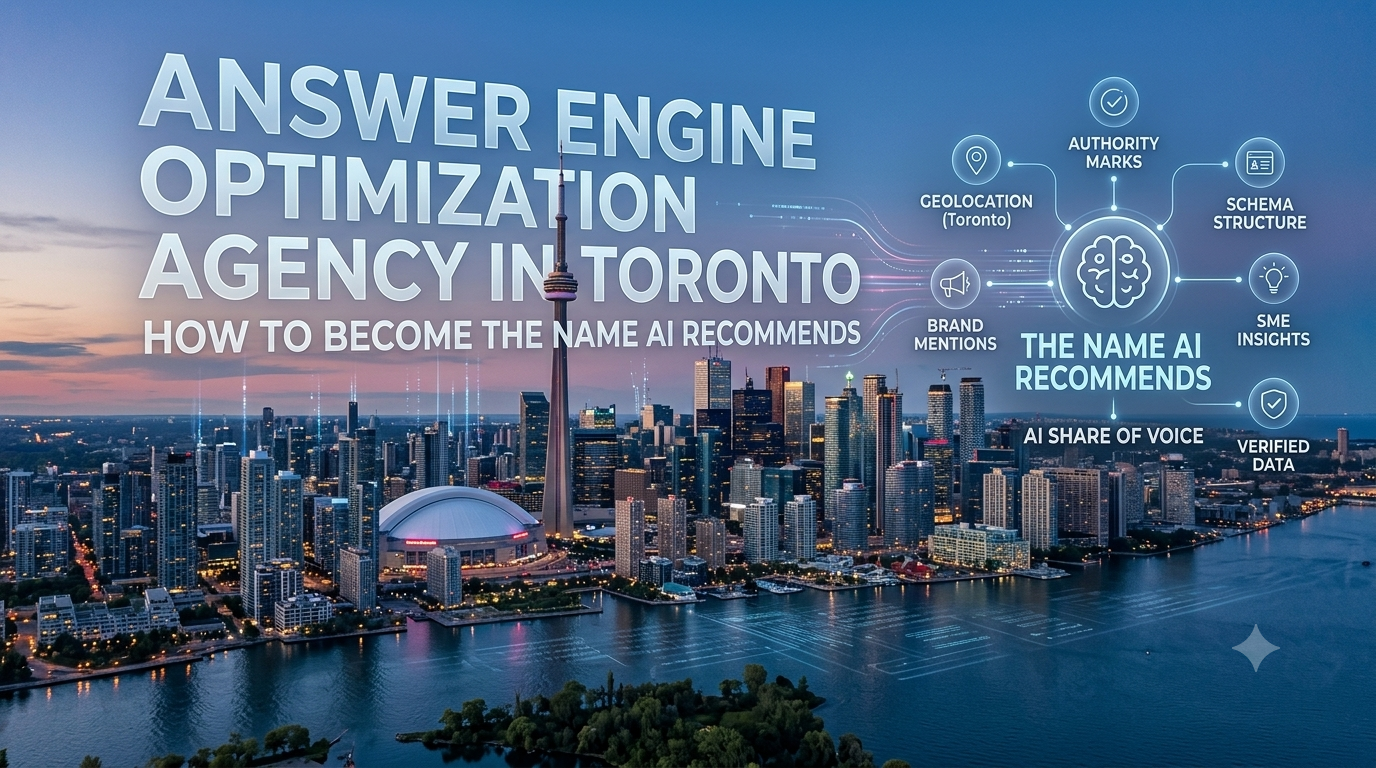
Answer Engine Optimization Agency in Toronto: How to Become the Name AI Recommends

An operations director at a 60-person logistics firm in Mississauga opens ChatGPT, not Google, and types: “Which managed IT providers near Toronto support a 60-person Microsoft 365 office, offer French-language help desk support, and can get a technician to Mississauga the same day?” She’s hypothetical. Her question is exactly the kind buyers now type.
Three named companies come back, each with a one-line reason and a source link. She emails all three before lunch.
Now say you run the IT firm that ranks fourth on Google for “managed IT services Toronto.” You have the French-speaking help desk. You have a technician in Mississauga. You weren’t named, and you’ll never know she asked.
Closing that gap is what an Answer Engine Optimization agency in Toronto does. This guide walks through how AI tools choose those three names, what changes from traditional SEO (and what doesn’t), what LLM SEO services should actually include, and how to measure the result in pipeline instead of traffic.
What AEO and GEO Mean, and Why Toronto Feels It First?
Before getting into how those three names were picked, it’s worth pinning down the vocabulary, because every other answer engine optimization agency in Toronto uses these terms loosely. The definitions are short. The reason Toronto businesses should care sooner than most takes a little longer, and it follows the definitions below.
SEO (search engine optimization) is the familiar one: earning rankings and clicks in Google’s results. The other three terms are newer:
- AEO (answer engine optimization) is structuring your content so AI tools and features like Google’s AI Overviews can lift it as a direct answer.
- GEO (generative engine optimization) is shaping the wider set of signals (your site, reviews, directory listings, third-party mentions) that large language models (LLMs) draw on when they write a recommendation.
- RAG (retrieval-augmented generation) is the process where an AI system searches for current sources, pulls passages from them, and writes its answer from those passages. Our explainer on how RAG pulls your data covers the mechanics.
Toronto has a specific reason to pay attention. The city is home to the Vector Institute, the AI research institute launched in 2017 alongside the University of Toronto, and to Cohere, one of the few Canadian companies building its own large language models. That concentration puts a lot of the people who buy B2B services here in daily contact with AI tools, and research habits tend to follow work habits.
Knowing the terms is the easy part. The harder question is what happened inside ChatGPT between the director’s question and those three names.
How AI Engines Choose Which Businesses to Name?
The director’s question had four constraints: company size, Microsoft 365, French-language support, and same-day service in Mississauga. No single page on anyone’s website answers all four, so the engine has to assemble an answer from pieces. Here are the four things that happen while it does.
It Splits One Question Into Several Searches
Google’s documentation on AI features in Search says AI Overviews and AI Mode may use “query fan-out,” issuing multiple related searches across subtopics and data sources to build a response. ChatGPT search and Perplexity also run live searches before answering.
So the director’s single question quietly becomes several: French-language IT support in Toronto, same-day technicians in Mississauga, Microsoft 365 providers for small offices. Every constraint is a separate chance to be found, or missed.
It Looks for Entities It Can Recognize
An entity is your business as a defined thing with clear attributes: name, location, services, languages, service area. Engines match constraints against those attributes.
If your site mentions “the GTA” once, in a footer graphic, the engine can’t confirm you serve Mississauga. If it says so in plain text, on a service-area page, and in your structured data, the match is easy.
It Checks What Other Sources Say About You
AI answers lean on agreement across sources. A firm that claims French support on its own website, with no one else mentioning it, is a riskier pick than a firm whose Google reviews keep saying “Marc answered in French and fixed it in an hour.”
Directories, reviews, industry associations, local news, and Reddit threads all feed this picture. Your website is one witness. The engine wants corroboration.
It Pulls Passages, Not Whole Pages
With RAG, the system retrieves chunks of text and writes from those chunks. A paragraph that reads “Our help desk supports English and French, and our technicians cover Mississauga, Brampton, and Etobicoke with same-day on-site visits” is easy to lift and quote.
The same facts scattered across a vague About page, a PDF brochure, and a staff bio are not. The engine won’t do the detective work for you.
Put those four steps together and a pattern shows up: the engine rewards clarity and corroboration. Much of that is ordinary good SEO, which is worth being honest about before anyone sells you something new.
Traditional SEO vs AEO: What Changes and What Stays
Some agencies pitch AEO as a replacement for SEO. Google’s own guidance says otherwise: “There are no additional requirements to appear in AI Overviews or AI Mode, nor other special optimizations necessary.” A page still has to be indexed and eligible to show a snippet before it can appear as a supporting link, so the foundation stays. The comparison below shows what changes on top of it.
| Aspect | Traditional SEO | AEO and GEO |
| Main goal | Rankings and clicks to a URL | Being named and cited inside the answer |
| Unit of competition | The page | The passage and the entity |
| Authority signals | Backlinks | Backlinks plus reviews, mentions, and consistent facts across the web |
| Content shape | Keyword-targeted articles | Direct answers, specific facts, front-loaded summaries |
| Success metric | Position and traffic | Citation frequency, AI share of voice, pipeline |
Here’s the uncomfortable part. If your site is slow, half-indexed, or full of thin pages, fix that first. AEO on a broken foundation is decoration, and any answer engine optimization agency in Toronto that skips the technical audit to sell you “AI visibility” is selling you the decoration. Our comparison of GEO and traditional SEO goes further on what to change first.
And if every customer you have finds you by walking past your shop on Queen West, none of this is urgent. AEO pays off when buyers research before they call, which describes most B2B services and a growing share of local ones.
Once the foundation is sound, the AEO layer comes down to specific, repeatable work. That’s where LLM SEO services earn their fee, or don’t.
What LLM SEO Services in Toronto Should Include?
LLM SEO is the hands-on side of AEO and GEO: the changes that make your business easy for large language models to find, understand, and quote. The label gets stuck on a lot of vague retainers, so it helps to know what the actual work looks like. Here are the four pieces a serious engagement should cover.
1. RAG-Ready Content Chunking
Retrieval systems grab sections, so each section should stand on its own. That means self-contained blocks of roughly 100-300 words, each answering one question, with the answer in the first sentence or two and a heading that matches how people ask.
For the IT firm, that’s a section titled “Do You Offer French-Language IT Support?” that answers yes, names the hours, and says which offices it covers. Specific facts beat adjectives.
There’s research behind this. The paper that coined the term GEO found that methods such as citing sources, adding quotations, and including statistics could raise a source’s visibility in generative engine responses by up to 40%.
2. Schema Markup That States the Facts
Schema markup is a standardized vocabulary from schema.org, added to your pages as code, that labels facts machines can read: business type, address, service area, languages, hours, and FAQs. Google recommends the JSON-LD format where your setup allows it.
For a Toronto service business, the core types are Organization, LocalBusiness, Service, and FAQPage, with properties like areaServed and availableLanguage doing the quiet work of confirming “Mississauga” and “French.” Our guide to schema markup for AEO covers this implementation.
3. Prompt Mapping for Multi-Constraint Questions
Keyword tools will tell you how many people search “managed IT Toronto.” They won’t show you the four-constraint question from the intro. Prompt mapping fills that gap.
The process is simple but takes discipline: collect the real questions buyers ask (from sales calls, support tickets, RFPs, and review text), break each one into its constraints, and check whether your site states a clear answer to every constraint. The gaps become your content plan.
4. Entity and Consensus Building Beyond Your Website
The last piece happens off your site. Your business name, address, and phone number should match exactly across Google Business Profile, Yelp.ca, Canada411, YellowPages.ca, and industry directories. Inconsistent listings make the engine less sure you’re one business.
Beyond listings, you want reviews that mention specifics, and mentions in places Canadian buyers trust: trade publications, association member pages, podcasts, community forums. This is the slowest piece of Generative Engine Optimization in Canada or anywhere, and the hardest to fake.
None of this is guesswork if you measure it. Which raises the question every Toronto business owner should ask before signing anything: how will we know it’s working?
How to Measure Whether Answer Engine Optimization Is Working?
Traffic is the wrong scoreboard for AEO. When an AI answer names you, the buyer may never visit your site first; the director in Mississauga emailed three firms straight from the chat window. Measurement has to follow the buyer, not the click. The following are the three numbers worth tracking.
- AI share of voice. Run a fixed set of buyer prompts every month across ChatGPT, Perplexity, Gemini, and Google AI Mode, and record how often you’re named against your competitors. Our AI brand visibility audit guide shows how to set this up.
- Citation frequency. Track how often your own pages appear as linked sources in those answers. Being named is good; being the cited source behind the name is better, because it sends the buyer to your page.
- Pipeline from AI referrals. Tag visits from chatgpt.com and perplexity.ai in your analytics, add an AI option to your “How did you hear about us?” field, and have sales ask on first calls. This is the number your CFO cares about.
One honest warning: AI answers vary from run to run, so read trends over months, not single screenshots. A firm that panics over one bad Tuesday result will rewrite pages that were working.
Those three numbers turn AEO from a vague promise into a monthly report you can hold an answer engine optimization agency in Toronto to. Here’s how we run it.
How Gowishy Works as an Answer Engine Optimization Agency in Toronto?
Everything above touches strategy, writing, code, and off-site reputation at once. That’s why it rarely works when it’s split across a freelancer, a web developer, and a PR contact who never talk to each other. Here’s how we handle it instead.
Gowishy runs on a dedicated pod: an SEO Specialist, an AEO and GEO Strategist, a Content Strategist and Writer, a Product Marketing Strategist, a Web Designer, and a Web Developer, on one monthly investment. We do not start with keywords. We start with the business.
Take the IT firm from the intro. In our process, Understand means learning that French-language support and same-day Mississauga visits are real differentiators the market barely knows about. Position means deciding to lead with them. Map demand means finding the prompts where those constraints show up. Build means writing the passages, shipping the schema, and fixing the listings. Grow means running the share-of-voice prompts every month and adjusting.
We work with businesses across Toronto and Canada, and we can’t promise ChatGPT will name you. Nobody honestly can. What we can do is make sure that the next time someone asks a question you’re built to answer, the engine finds clear facts, matching evidence, and a good reason to say your name. If you’d like to be in that answer, talk to us at Gowishy.
Frequently Asked Questions
1. What does an Answer Engine Optimization agency in Toronto do?
It makes your business easy for AI tools like ChatGPT, Perplexity, and Google AI Overviews to find, understand, and recommend. The work covers content written as direct answers, schema markup, consistent listings across Canadian directories, review and mention building, and monthly tracking of how often AI answers name you against competitors.
2. Is AEO replacing SEO?
No. Google says there are no special requirements to appear in AI Overviews beyond being indexed and eligible for a snippet, so technical SEO, quality content, and backlinks still matter. AEO builds on that foundation by shaping content into quotable passages and building the third-party consensus AI engines check before naming a business.
3. What’s the difference between AEO and GEO?
AEO focuses on your content: structuring pages so an AI system can lift a clear, direct answer. GEO, or Generative Engine Optimization in Canada, is broader and covers every signal a large language model weighs when it writes a recommendation, including reviews, directory listings, press mentions, and forum discussion. In practice, a good program runs both together.
4. How long does Answer Engine Optimization take to work?
On-site changes like rewriting key pages and adding schema can ship within weeks, and AI tools that search live may pick them up soon after. Off-site consensus, such as reviews and earned mentions, builds over months. Track AI share of voice monthly and judge the trend rather than any single answer.
5. Do small Toronto businesses need LLM SEO services?
It depends on how customers find you. If buyers research before they call, comparing options on price, location, or specialty, AI answers are already shaping their shortlist and LLM SEO is worth doing. If most customers walk in off the street or come through referrals, fix your Google Business Profile first.
Related articles
-

How Much Should a Toronto Small Business Actually Spend on GEO?
Most Toronto small businesses should expect GEO quotes somewhere between $1,500 and $5,000 CAD a month, with multi-location and highly competitive businesses going past $5,000. Treat those as typical market ranges, not a price list. We haven’t seen an independent, published survey of GEO pricing in Canada, so the figures in this guide are estimates…
-
5 AI Search Optimization Tips Toronto Businesses Can’t Ignore (AEO and GEO)
An awkward admission for an agency to make: there is no secret trick to getting your business named by ChatGPT or Google’s AI Overviews. Google says so itself. Its guidance for site owners states that “there are no additional requirements to appear in AI Overviews or AI Mode, nor other special optimizations necessary” (Google Search…
-
How to Master AEO and GEO for Small Business in Toronto: A Success Guide
The story in this guide is hypothetical. The clinic is invented, and so is everything that happens to it. Every step it takes, though, is a real part of AEO for small business in Toronto, and one you can start this month. Picture a two-location physiotherapy clinic, one on Queen Street East in Leslieville and…