



How Much Should a Toronto Small Business Actually Spend on GEO?

Most Toronto small businesses should expect GEO quotes somewhere between $1,500 and $5,000 CAD a month, with multi-location and highly competitive businesses going past $5,000. Treat those as typical market ranges, not a price list. We haven’t seen an independent, published survey of GEO pricing in Canada, so the figures in this guide are estimates based on how agencies commonly scope this work. The closest hard data covers SEO: Ahrefs surveyed 439 SEO providers and found the most common monthly retainer was $501 to $1,000 USD, with an overall average of $2,917 a month.
Here’s what most pricing pages skip. When you compare SEO vs. GEO cost for SMBs in Toronto, a large share of what you pay for overlaps. SEO (search engine optimization) gets your pages ranked in Google’s links. GEO (generative engine optimization) is the work of getting your business named and cited when AI tools like ChatGPT, Perplexity, and Google’s AI Overviews write an answer. A sensible GEO budget pays for the extra layer on top of solid SEO, and you shouldn’t be billed twice for the foundation underneath it.
This guide breaks down where the money goes, what typical ranges look like by business type, what pushes a quote up, and what a legitimate package should include.
SEO vs GEO Cost for SMBs in Toronto: Where the Money Goes?
The ranges above only make sense once you see what each service is buying. SEO and GEO share a foundation, and Google itself says its AI features don’t need a separate playbook. The following table compares the two line by line.
Google’s guidance on AI features is blunt: “There are no additional requirements to appear in AI Overviews or AI Mode, nor other special optimizations necessary.” That matters for your budget, because it means the extra cost of GEO should go to three things SEO alone doesn’t cover well: content structured so AI tools can quote it, mentions of your business on other trusted sites, and regular checks on what ChatGPT, Perplexity, and Gemini (none of which are Google Search) actually say about you.
| Aspect | SEO | GEO |
| What you’re paying for | Rankings and clicks from Google’s links and map pack | Being named, cited, and described accurately in AI answers |
| Core deliverables | Technical fixes, keyword-mapped pages, links, Google Business Profile | Answer-first content, entity building, third-party mentions, AI answer tracking |
| Overlap | Crawlability, site speed, schema, and content quality serve both | Depends on that SEO base; weak SEO makes GEO slower and costlier |
| Typical time to early signals | Often three to six months | Similar or longer, and less predictable run to run |
| How results are reported | Rankings, organic traffic, enquiries | Citation frequency, AI share of voice, accuracy of AI descriptions |
| Where cost grows | Number of pages, links, and locations | Number of prompts tracked, platforms monitored, and off-site outreach |
If you already pay for decent SEO, GEO should cost you the increment, not a second full retainer. If you pay for nothing today, expect a combined program priced closer to the upper part of the range, because the foundation has to be built first. Ahrefs’ numbers are in US dollars and drawn from providers worldwide, so convert at the Bank of Canada’s current rate before comparing them with a Toronto quote.
Which end of the range you land on depends mostly on what kind of business you run.
Typical Monthly GEO Budgets by Business Type in the GTA
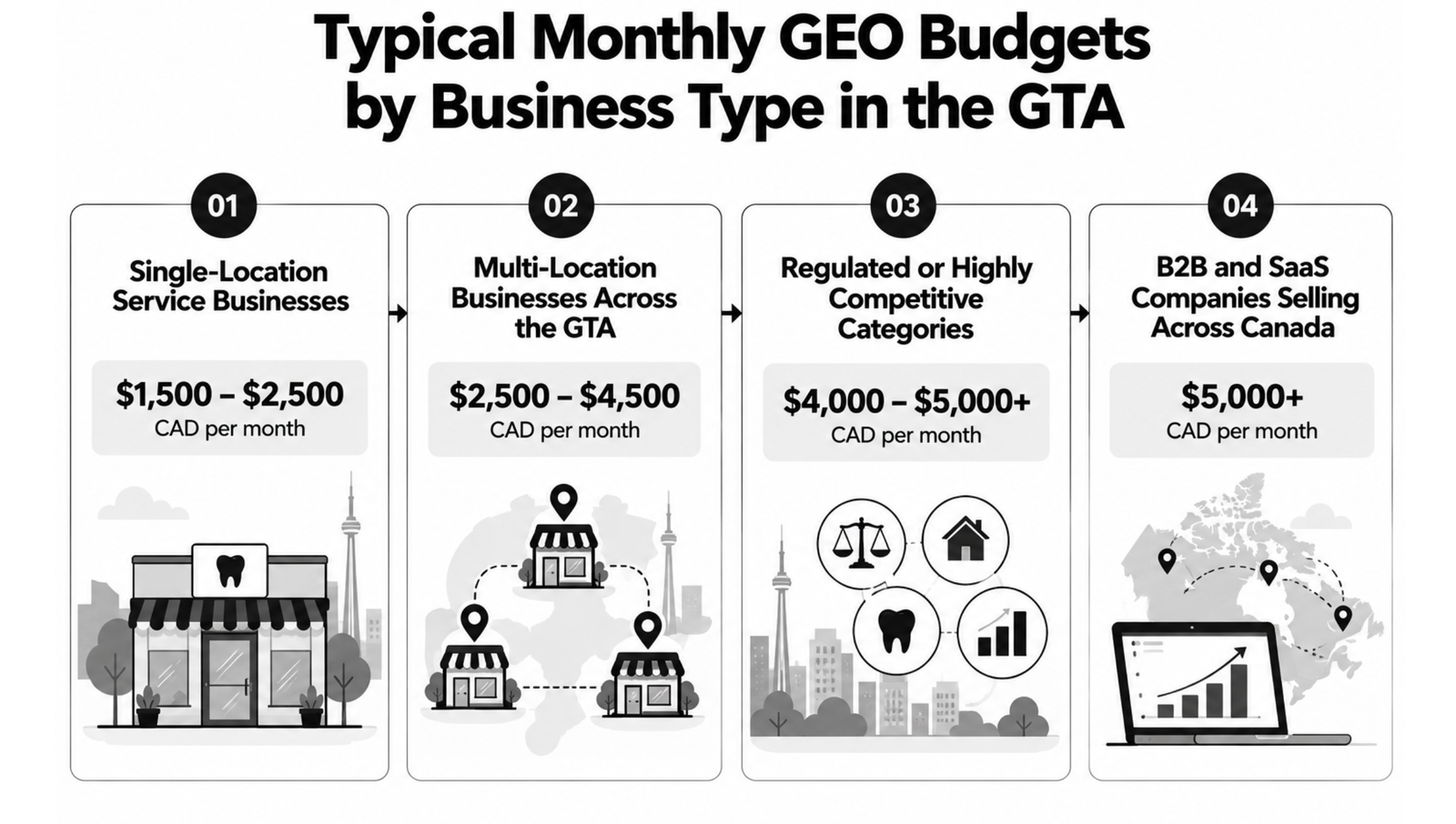
Business type shapes a quote more than any other single factor, because it decides how many places, questions, and competitors the work has to cover. The ranges below are estimates of where Toronto market quotes commonly fall, not published benchmarks. Here are four common profiles.
Single-Location Service Businesses
A dental office in the Junction, a physio clinic in Leslieville, or a renovation contractor serving one part of the city typically sits around $1,500 to $2,500 CAD a month. The work centres on one Google Business Profile, accurate listings on Canadian directories like Yelp.ca and YellowPages.ca, a few dozen answer-first pages, and tracking a short list of local prompts.
Multi-Location Businesses Across the GTA
A business with sites in Etobicoke, Mississauga, and Markham often lands between $2,500 and $4,500. Each location needs its own profile, its own location page and markup, and its own set of tracked questions, because “near me” answers change by neighbourhood.
Regulated or Highly Competitive Categories
Personal injury law, real estate, cosmetic dentistry, and financial advice tend to run $4,000 to $5,000 or more. Competitors are already investing heavily, and content in these fields needs careful review before it goes live, which adds hours that a bakery’s content never would.
B2B and SaaS Companies Selling Across Canada
National B2B firms usually start above $5,000. They’re competing for buyer questions across provinces, sometimes in English and French, and the useful measure is pipeline from qualified accounts rather than local calls. Our guide to measuring the ROI of GEO covers how to track that.
Within any of these profiles, a few specific factors move a quote up or down.
What Pushes a GEO Quote Up or Down?
Two businesses of the same type can receive very different quotes for honest reasons. The gap usually comes down to scope, and a good agency should be able to explain it in plain terms. The following three factors account for most of the difference.
- Locations and service areas. One storefront in Liberty Village is a smaller job than a team serving the whole GTA from North York to Oakville. Every extra service area adds listings, pages, and prompts to monitor.
- Content volume. A business that needs 20 new answer-first pages a quarter costs more than one that needs four, especially if the topics demand expert review.
- Technical debt. This means the backlog of site problems that slow everything else down: broken pages, missing schema, slow load times, or a site AI crawlers can’t read properly. Fixing it is often a one-time cost, but it can double the first few months of a quote.
Some things shouldn’t raise your price at all. A long list of tools, a “proprietary AI platform,” or a 40-page monthly report adds cost without adding results for most small businesses. If a quote is high, ask which line items map to the three factors above.
Once the scope is clear, the next test is whether the package itself is legitimate.
What a Legitimate GEO Agency Package Includes?
Generative engine optimization pricing is only meaningful if you know what’s in the box. Compare AI SEO pricing for small business packages closely and you’ll find plenty are rebranded blog-writing plans with a new label. Here are the four components a real GEO package should cover.
A Baseline Audit of Your Site and AI Visibility
Before any work starts, the agency should check whether AI crawlers can access your site, whether your structured data is valid, and how AI tools currently describe you. That last part means running a fixed list of real customer questions in ChatGPT, Perplexity, and Google AI Mode and recording where you appear. Without a baseline, no later report can prove anything changed.
Entity Building and Off-Site Mentions
AI tools are more confident recommending a business that other sources describe consistently. Entity building is the work of making your business facts (name, locations, services, hours) match everywhere and earning mentions on trusted third-party sites: industry associations, local publications, partner pages, and review platforms. This is the part of GEO that SEO retainers most often leave out.
Content Built to Be Quoted
Pages should open with a direct answer of 40 to 60 words, use clear headings, and include specifics an AI tool can repeat: services, prices where you publish them, areas served, and credentials. Expect fewer, sharper pages rather than a high-volume blog calendar.
LLM Monitoring and Reporting Tied to Pipeline
LLM monitoring means tracking, month over month, how often large language models name your business and whether what they say is accurate. Good reporting ties those citations to outcomes that matter to you, like enquiries, booked calls, or qualified pipeline, rather than traffic alone. Answers vary between runs, so look for trends over several months.
With a clear idea of what you should be buying, setting the budget itself gets much easier.
How to Set a GEO Budget You Can Defend?
A local business GEO budget in Canada should start from what a new customer is worth to you, not from what a competitor says they spend. This keeps the decision tied to revenue and gives you a fair test after six months. Here’s a simple way to work it out.
Start with the value of one new client over a year. If that figure is $3,000, a $2,000 monthly budget needs roughly one extra client a month to break even. If your average client is worth $300, the same budget needs nearly seven, and GEO at that level probably isn’t the right first move. Give any program six months before judging it, because the first two are usually spent on audits, fixes, and listings that produce no visible change.
This is also where we’ll say something some agencies won’t. If your total budget is under $1,500 a month, you’re usually better off putting all of it into solid SEO and your Google Business Profile, and doing basic GEO hygiene yourself. That advice doesn’t apply if you’re in a category where buyers already ask AI tools first, such as B2B software, where waiting can cost more than starting small.
Watch for the usual warning signs: guaranteed rankings or guaranteed AI citations, no baseline audit, and long lock-in contracts. Our guide to hiring an SEO agency without getting burned covers the full list.
The last question is who does the work, and how it’s priced.
How Gowishy Approaches GEO Pricing
Part of what you pay for in any quote is coordination. A small business that hires an SEO freelancer, a writer, a developer, and a GEO consultant pays four margins and manages four handoffs. Here’s how Gowishy structures it instead.
Gowishy doesn’t publish a price list, because scope varies too much for a single number to be honest. What we offer is one monthly investment for a six-role pod: an SEO Specialist, an AEO and GEO Strategist, a Content Strategist and Writer, a Product Marketing Strategist, a Web Designer, and a Web Developer. Pricing is startup-friendly and monthly, and SEO, AEO (answer engine optimization), GEO, and web work sit in the same plan rather than separate retainers.
Every engagement follows the same path: Understand, Position, Map demand, Build, and Grow. Scope comes out of the first step, so the quote reflects your locations, content needs, and technical debt rather than a package tier.
The $1,500 to $5,000 range at the top of this page is a fair starting point for any Toronto digital marketing cost conversation. Where you should land inside it depends on your business. If you’d like a quote built around yours, talk to us at Gowishy.
Frequently Asked Questions
How much does GEO cost for a small business in Toronto?
Typical market quotes for GEO in Toronto range from about $1,500 to $5,000 CAD a month, with multi-location businesses, competitive categories, and national B2B firms often paying more. These are estimates, not published benchmarks. The final number depends on locations served, content volume, technical debt, and whether solid SEO is already in place.
Is GEO more expensive than SEO?
GEO adds work on top of SEO rather than replacing it, so a combined program usually costs more than SEO alone. If your SEO is already in good shape, the added cost should cover answer-first content, entity building, off-site mentions, and AI answer monitoring. You shouldn’t pay a second full retainer for foundation work you already have.
Can I invest in GEO without doing SEO?
Not effectively. Google states there are no special optimizations required for its AI features beyond SEO fundamentals, and other AI tools also rely on pages they can crawl and trust. Without crawlable pages, accurate listings, and a working Google Business Profile, GEO spending has little to build on.
How long does it take to see results from GEO?
Plan on roughly six months before judging a GEO program. The first two months typically go to audits, technical fixes, and listing corrections with little visible change. After that, track how often AI tools name your business for a fixed set of prompts, and judge progress on the monthly trend.
What should a monthly GEO report include?
A useful report shows citation frequency for a fixed list of real customer questions, which AI platforms mention you, whether their descriptions are accurate, and how those changes connect to enquiries or pipeline. It should also list the work completed that month. Reports built only on traffic or vanity metrics don’t tell you whether GEO is working.
Related articles
-

5 AI Search Optimization Tips Toronto Businesses Can’t Ignore (AEO and GEO)
An awkward admission for an agency to make: there is no secret trick to getting your business named by ChatGPT or Google’s AI Overviews. Google says so itself. Its guidance for site owners states that “there are no additional requirements to appear in AI Overviews or AI Mode, nor other special optimizations necessary” (Google Search…
-

How to Master AEO and GEO for Small Business in Toronto: A Success Guide
The story in this guide is hypothetical. The clinic is invented, and so is everything that happens to it. Every step it takes, though, is a real part of AEO for small business in Toronto, and one you can start this month. Picture a two-location physiotherapy clinic, one on Queen Street East in Leslieville and…
-

How to Choose the Best SEO Company in Toronto (2026 Update)
“Deciding to hire a company or person to do search engine optimization (SEO) for your website in Google Search is a big decision that can potentially improve your site’s visibility and save you time, but you can also risk damage to your site and reputation.” That line comes from Google itself, on its Search Central…