


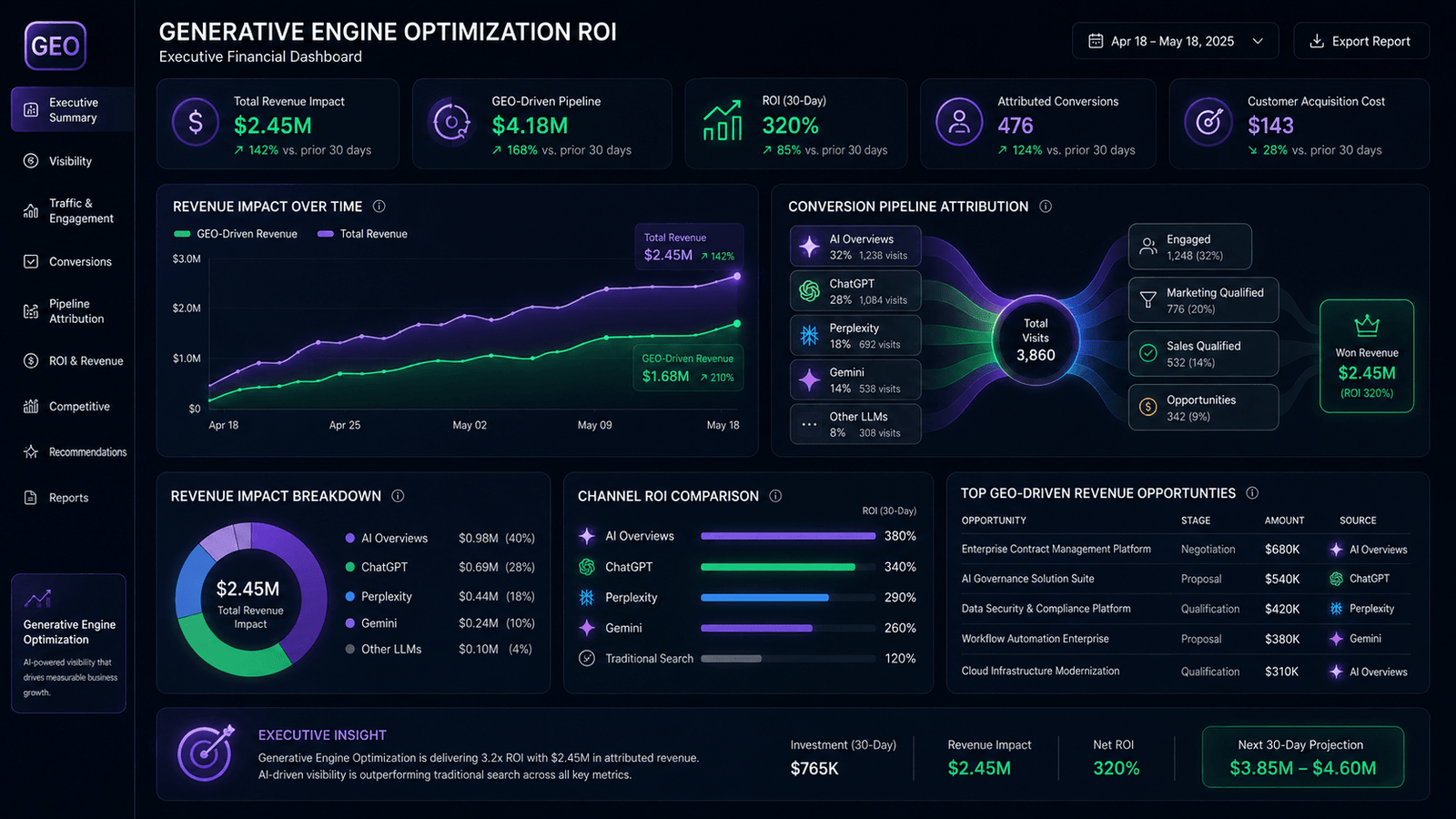
How to Measure the ROI of Generative Engine Optimization (GEO)

Pitching a budget for Generative Engine Optimization used to be easy because the novelty alone was enough to get leadership excited. Fast forward to today, and your finance team wants to see actual dollar returns, not just a spreadsheet showing that ChatGPT cited your blog. Measuring returns on generative search feels tricky because AI platforms synthesize answers directly; they do not always send a neat stream of trackable web clicks back to your site.
If you try to measure GEO success using traditional analytics tools built for blue links, your program will look like a failure even when it is actively winning buyers. People might read a glowing recommendation of your product inside Perplexity or Claude, skip clicking the source link, and type your web address directly into their browser twenty minutes later.
To prove real financial value to your executive board, you need an attribution strategy designed specifically for conversational search. Here is how you connect AI citations to bottom-line revenue and measure true return on investment.
Why Standard Analytics Engines Miss the Full Picture
Traditional analytics platforms rely almost entirely on referral links and immediate sessions. When a prospect clicks an organic link from a standard search engine, a cookie drops, a session starts, and path tracking begins.
Generative platforms break this clean path in two major ways:
- Zero-Click Recommendations: AI search tools frequently answer the user’s prompt so completely that the user gets their recommendation without needing to visit the cited site.
- Untracked Referral Paths: Many conversational apps strip referral data entirely when users do click through, dumping those visitors into your analytics as direct traffic.
Relying solely on direct referral links from AI platforms usually captures only a tiny fraction of the actual business generated by GEO. To build an accurate ROI model, you have to track both direct traffic and the indirect pipeline created by AI recommendations.
The 3-Layer Attribution Framework for GEO
Instead of looking for a single magic metric, measure your returns using a three-part framework that captures visibility, pipeline activity, and actual closed revenue.
Layer 1: Leading Visibility Metrics (Upstream Impact)
Before you can track revenue, you need to prove AI platforms are actually talking about your company. These metrics serve as early indicators that your optimization efforts are working:
- Inclusion and Citation Rate: The percentage of target prompts where an AI engine explicitly names your brand or links to your content as a source.
- Share of Voice in AI: How frequently your company is recommended compared to your top three rivals across key industry topics.
- Recommendation Sentiment: Whether the AI engine presents your product as a market leader, a budget alternative, or a solution with drawbacks.
While visibility does not equal cash in hand, a rising Share of Voice in AI engines consistently predicts a spike in brand search volume two to four weeks down the line.
Layer 2: Pipeline Attribution and Buyer Intent
This layer tracks how conversational recommendations move prospective buyers deeper into your sales funnel.
- Self-Reported Attribution: Add an open-text or dropdown question on your demo and contact forms asking: “How did you first hear about us?” You will quickly spot prospects stating they found you through ChatGPT, Claude, or Perplexity.
- AI-Referred Conversion Rate: Visitors coming directly from AI citation links typically convert at a significantly higher rate than standard organic traffic because the AI tool has already done the shortlisting work for them.
- Branded Search Lift: Track weekly search volume for your brand name. When your citation rate inside generative engines surges, branded search volume almost always climbs alongside it as users verify your site.
Layer 3: Financial Return and Pipeline Velocity
This is the final calculation your leadership team cares about: comparing total program investment against newly generated revenue.
- GEO-Attributed Closed Deals: Sum the contract value of all deals where the buyer originated from an AI referral link or cited an AI platform in their self-reported attribution.
- Sales Cycle Acceleration: Prospects who discover your brand via conversational recommendations usually close faster because they enter the sales funnel with higher intent and fewer basic questions.
How to Calculate Your GEO ROI Multiple
Once you gather data across all three attribution layers, putting together the final calculation is straightforward:
GEO ROI = (Revenue attributed to GEO – Total GEO Investment /Total GEO Investment) x 100
When calculating your total program investment, make sure to include all software costs for AI tracking tools, internal team hours, agency fees, and content creation expenses.
On the revenue side, include both direct conversions from AI referral links and closed opportunities logged through self-reported attribution. Presenting this blended model gives your leadership team an honest, defensible picture of how generative visibility drives commercial growth.
Proving Value in a Cookieless Search Landscape
The brands that struggle to justify their optimization budgets are usually the ones trying to fit new search behaviors into old analytics templates.
By tracking upstream visibility alongside downstream pipeline metrics, you can clearly demonstrate how Generative Engine Optimization fuels your sales team, protects your market share, and delivers an undeniable return on investment.
If you need assistance in measuring the ROI of your Generative Engine Optimization strategy and building an executive-ready reporting model, talk to us at Gowishy; we will help you connect AI visibility directly to pipeline revenue.
Related articles
-

The Guide to Ranking in Google AI Overviews & LLMs
Google’s search results look a lot different than they did a few years ago. The first result isn’t a blue link that provides you with the most relevant result anymore. It’s an AI-generated summary of what you searched about. For Canadian businesses that have grown accustomed to the old strategies, this shift is a major…
-

Toronto’s Premier Answer Engine Optimization (AEO) Agency: Leading the Shift to AI-First Visibility
As Gen-AI transforms how people and companies discover information, traditional strategies are stepping aside to Answer Engine Optimization (AEO) and Generative Engine Optimization (GEO). If you have a brand and it isn’t being synthesized, recommended, and cited inside the latest tools like ChatGPT, Claude, Perplexity, and Google AI, you’re becoming invisible to a large part…
-
The Ultimate Buyer’s Guide: How to Hire an SEO Agency Without Getting Burned
When you hire an SEO agency, it should be a deliberate decision that creates a genuine opportunity for your business. But all too often, for most business owners, it ends up feeling like a gamble, with aggressive sales pitches, over-the-top promises that never materialize, vague promises of top rankings, and dense technical jargon designed to…