


Generative Engine Optimization (GEO) vs. Traditional SEO: What You Need to Change Today

If you’ve opened a search bar lately, you’ve noticed things look a lot different from the past. Where there used to be a neat list of ten blue links, there’s now an AI-generated summary right at the top of the page, giving searchers instant answers without forcing them to click anywhere.
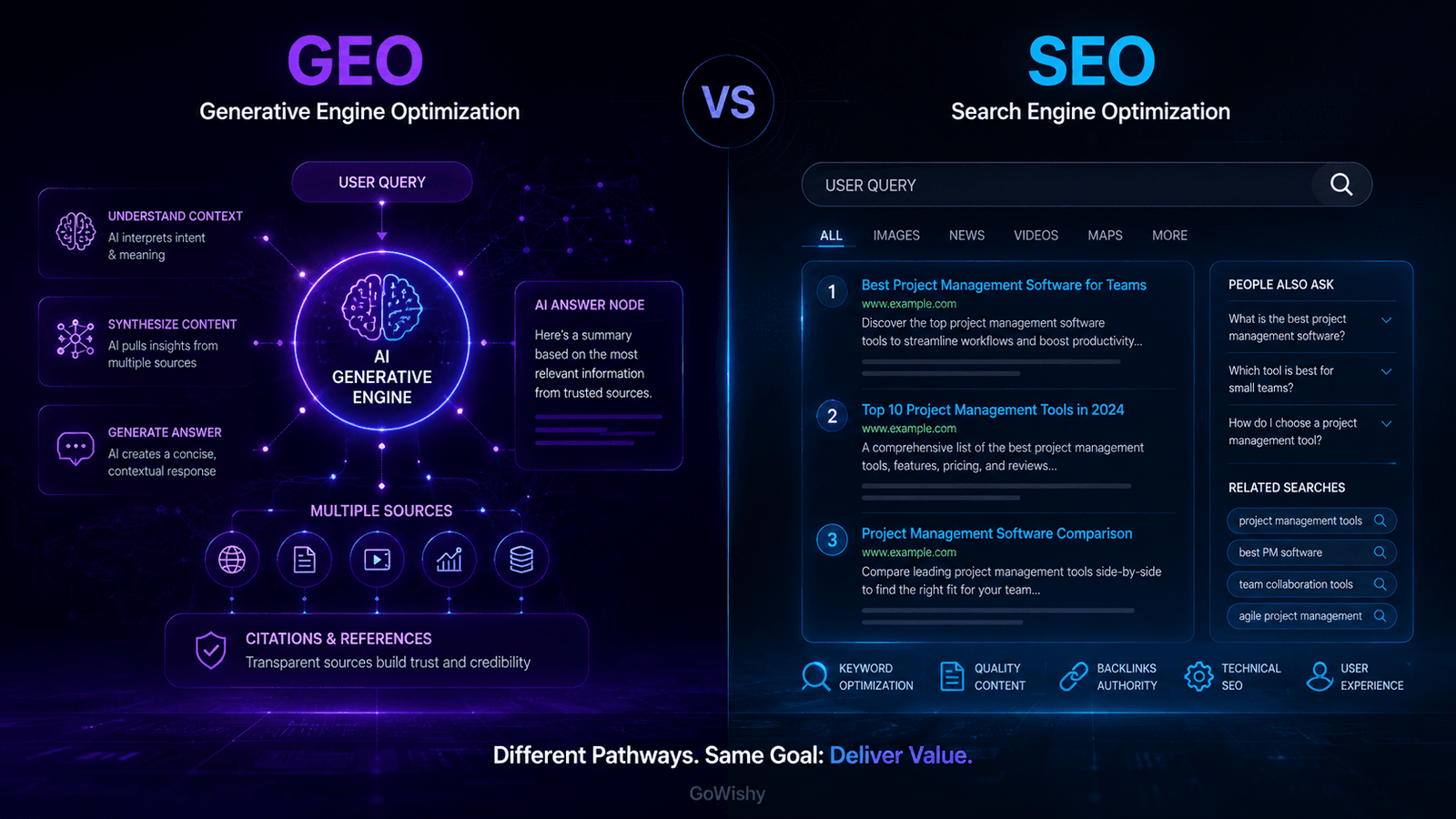
This shift has given rise to Generative Engine Optimization, or GEO. While traditional SEO was all about getting your website to rank at the top of search results, GEO is about getting your brand cited, quoted, and recommended inside the answers generated by AI search tools like ChatGPT, Claude, Perplexity, and Google’s AI Overviews.
It’s easy to panic and assume everything you know about search is obsolete, but that’s not quite the case. Here’s what’s actually changing, what’s staying the same, and how you can adapt your approach right now.
What Traditional SEO Got Right (and Where It Falls Short Now)
Traditional SEO isn’t dead, but its focus is definitely shrinking. For decades, the standard strategy was simple: find a high-volume keyword, write a page optimized for that term, get backlinks, and watch the traffic roll in.
That strategy worked when search engines were basically indexers. They matched words on a screen to words in a query. But today’s answer engines don’t just match keywords; they read, process, and summarize information from multiple sources to give users a single, direct answer.
If your entire search strategy relies on people clicking through to your site for basic definitions or surface-level facts, you’re going to see your organic numbers drop. When an answer engine gives searchers what they need in two seconds, they’re not going to scroll down to click your link.
The Core Differences: SEO vs. GEO
To thrive in this new landscape, you’ve got to understand how the rules are changing. Here’s a breakdown of how GEO stacks up against traditional search tactics:
|
Strategy Area |
Traditional SEO |
Generative Engine Optimization (GEO) |
|
Primary Goal |
Secure clicks and page views |
Gain brand citations and source mentions |
|
Content Style |
Targeted keyword placement |
Direct answers, structured data, and original data |
|
Authority Signals |
Backlinks and domain age |
Brand mentions across trusted third-party sites |
|
User Journey |
Search→ Click→ Read on website |
Search→ Read AI response → Convert or verify |
3 Big Strategy Shifts You Need to Make Today
You don’t need to throw away your entire marketing playbook, but you do need to tweak how you create and structure your content. Here’s where to focus your energy right now.
1. Ditch the Fluff and Lead with Direct Answers
AI models love clear, concise information they can easily extract and quote. If your articles take five paragraphs of backstory just to answer a simple question, answer engines will ignore you in favor of a site that gets straight to the point.
Adopt an inverted pyramid writing style: give the direct answer or key takeaway immediately, then follow up with the context, details, and nuance underneath.
2. Focus on “Un-Copyable” Content
Generative engines are great at summarizing public knowledge, but they can’t create original insights. If your content just regurgitates what ten other blogs have already said, an AI engine doesn’t need your page.
To stand out, publish content that AI can’t invent on its own:
- Proprietary data, research, and industry surveys.
- First-hand case studies and real-world results.
- Specific quotes and opinions from verified experts in your field.
When you offer unique data points, answer engines are forced to cite your brand as the original source.
3. Build Off-Page Authority Beyond Just Backlinks
Traditional SEO focused heavily on getting hyperlinked text from other sites. GEO cares just as much about unlinked brand mentions on places where real discussions happen.
Answer engines scan forums, social networks, review sites, and industry publications to figure out who’s actually trusted in a given space. If people on Reddit, Quora, or industry podcasts are talking about your product, AI models notice—and they’ll start recommending you when users ask for top solutions.
Adapting Without Overcomplicating
The rise of generative engines doesn’t mean search is ruined; it just means the bar for quality is higher than it used to be. The brands that win in this era will be the ones that stop writing for search bots and start creating genuinely authoritative, easy-to-digest content that both humans and AI engines can trust.
If you need assistance in optimizing your digital footprint so AI answer engines actually recommend your brand, talk to us at Gowishy, we’ll help you stay ahead of the curve and turn search AI into your biggest growth driver.
Related articles
-
The Guide to Ranking in Google AI Overviews & LLMs
Google’s search results look a lot different than they did a few years ago. The first result isn’t a blue link that provides you with the most relevant result anymore. It’s an AI-generated summary of what you searched about. For Canadian businesses that have grown accustomed to the old strategies, this shift is a major…
-
Toronto’s Premier Answer Engine Optimization (AEO) Agency: Leading the Shift to AI-First Visibility
As Gen-AI transforms how people and companies discover information, traditional strategies are stepping aside to Answer Engine Optimization (AEO) and Generative Engine Optimization (GEO). If you have a brand and it isn’t being synthesized, recommended, and cited inside the latest tools like ChatGPT, Claude, Perplexity, and Google AI, you’re becoming invisible to a large part…
-
The Ultimate Buyer’s Guide: How to Hire an SEO Agency Without Getting Burned
When you hire an SEO agency, it should be a deliberate decision that creates a genuine opportunity for your business. But all too often, for most business owners, it ends up feeling like a gamble, with aggressive sales pitches, over-the-top promises that never materialize, vague promises of top rankings, and dense technical jargon designed to…