


5 AI Search Optimization Tips Toronto Businesses Can’t Ignore (AEO and GEO)

An awkward admission for an agency to make: there is no secret trick to getting your business named by ChatGPT or Google’s AI Overviews. Google says so itself. Its guidance for site owners states that “there are no additional requirements to appear in AI Overviews or AI Mode, nor other special optimizations necessary” (Google Search Central).
So why does one Toronto accounting firm or HVAC company get recommended while the one down the street gets ignored? Usually it comes down to fundamentals done thoroughly, consistently, and in a format machines can read. The AI search optimization tips below are deliberately unglamorous. They’re also the ones that move results.
Two terms before we start. AEO, answer engine optimization, is the work of structuring your content so AI tools can lift it as a direct answer. GEO, generative engine optimization, is the broader effort to get your business cited inside answers from large language models like ChatGPT, Gemini, and Perplexity. For Toronto local AI search, the two overlap almost completely.
Why AI Answers Skip Most Toronto Businesses
If there’s no secret trick, the useful question is what goes wrong for the businesses that never get mentioned. The answer starts with how these tools build a response. Here’s the short version of that process and the three places most local businesses fall out of it.
Many AI tools use RAG, retrieval-augmented generation: they search the web or an index for relevant pages, pull out passages, and write an answer grounded in what they found, often with links to sources. Our explainer on how RAG pulls your data covers the mechanics. For a business owner, the key point is that the tool is choosing passages, not whole websites.
That’s where most Toronto businesses lose. First, the answer a customer wants is buried in the fourth paragraph of an “About Us” page, so there’s no clean passage to pull. Second, the facts conflict: one directory says the business is on Queen Street East, another has the old Danforth address, and the tool can’t tell which is current. Third, nothing outside the company’s own site confirms what it claims, because reviews are thin and say little beyond “great service!”
Each of those problems has a fix, and none of them requires a new platform. The five tips that follow map directly onto them.
5 AI Search Optimization Tips for Toronto Businesses
The tips run in roughly the order we’d tackle them, starting with your own pages and moving outward to directories, code, reviews, and the way customers phrase questions. Each one addresses a specific reason AI tools skip a business. Here are the five.
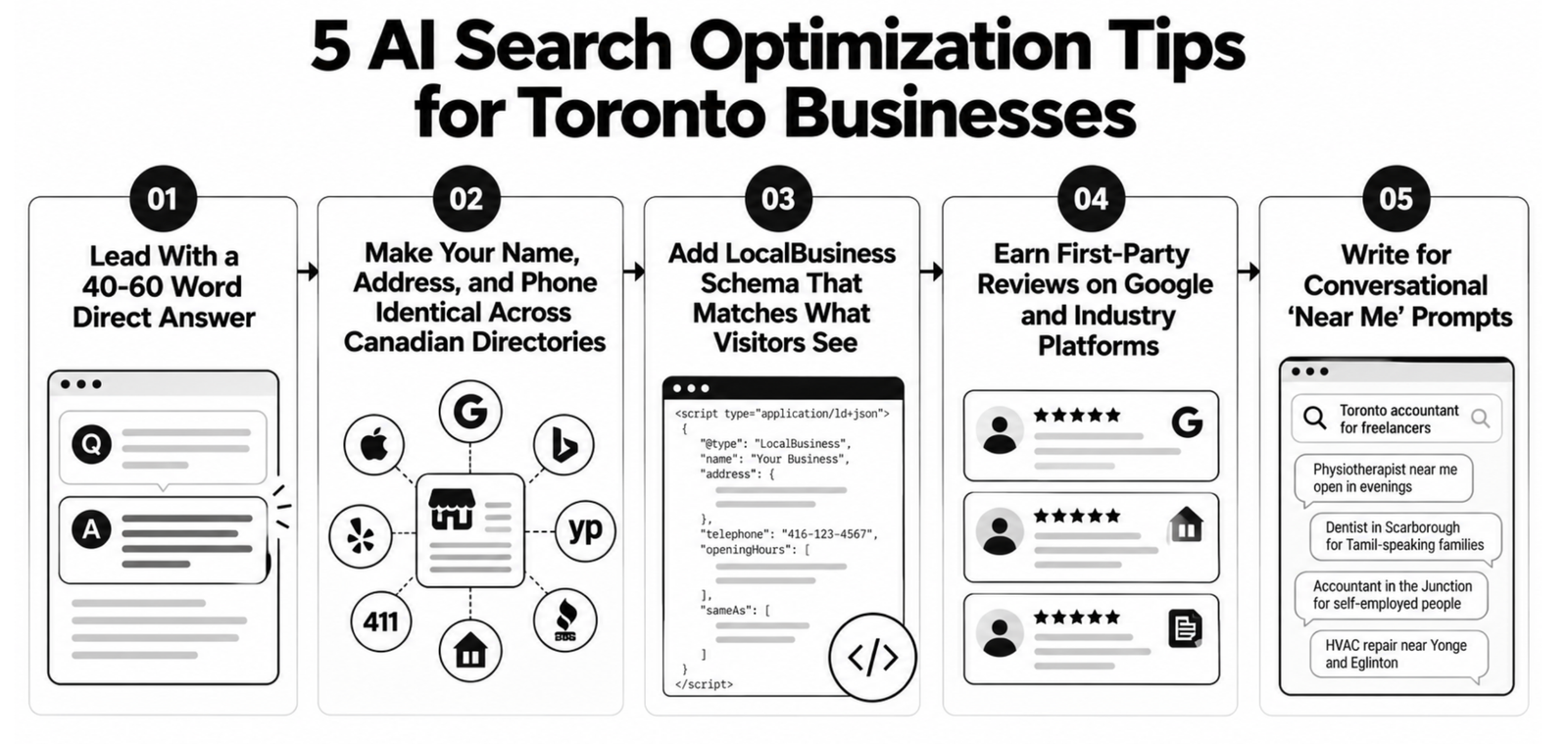
1. Lead With a 40-60 Word Direct Answer
AI tools pull passages, so give them a passage worth pulling. Under every question your page answers, write a 40-60 word summary that would make sense if it were the only thing someone read. That’s long enough to be complete and short enough to be quoted intact.
Take a Markham HVAC company answering “How long does a furnace replacement take?” A weak page opens with the company’s history. A strong one opens like this: “A typical furnace replacement in a detached home takes one working day. That includes removing the old unit, installing and testing the new one, and a safety check before the technician leaves. Older homes with ductwork issues can take longer, and we’ll tell you upfront.”
Put the question in a heading, the answer directly underneath, and the nuance after. Your customers skim the same way the machines do, so this helps both.
The most common mistake is hedging the answer into mush. “It depends on many factors” is true and useless. Give the typical case first, then explain what changes it. If a question honestly has no typical answer, say what the range depends on in one sentence and offer to quote.
2. Make Your Name, Address, and Phone Identical Across Canadian Directories
NAP stands for name, address, and phone number. When your NAP matches across sources, search engines and AI tools can be confident they’ve found the right business, and the same one every time. The work is tedious and worth it. Pick one exact format (is it “Suite 400” or “#400”?) and use it everywhere.
Then audit the places Canadian customers and data aggregators look:
- Google Business Profile, Apple Business Connect, and Bing Places
- Yelp.ca, YellowPages.ca, Canada411, and BBB
- Industry platforms, such as HomeStars for trades or your professional regulator’s public directory
Track every listing in a spreadsheet with its login and current details. Watch for the classic Toronto problem: a business that moved from Midtown to Leslieville three years ago and still has the old address on a dozen listings. Each one is a vote for the wrong location.
Two other traps are worth checking. Call-tracking numbers from old ad campaigns often end up on directory listings, so a business can appear to have four phone numbers. Duplicate listings, often created automatically after a move or rebrand, split your reviews and confuse everyone. Merge or remove duplicates through each platform’s support process rather than leaving them to sit.
3. Add LocalBusiness Schema That Matches What Visitors See
Schema markup is structured data code, usually written in JSON-LD, that labels facts on your page in a vocabulary machines understand. For local businesses, LocalBusiness schema (or a specific subtype like AccountingService or Dentist) states your name, address, hours, phone, and service area without ambiguity. Our guide to schema markup for AEO walks through the code.
Two honest caveats. Google’s AI features guidance says there’s “no special schema.org structured data that you need to add,” and it lists keeping structured data consistent with your visible text as a basic practice. And if you added FAQ markup hoping for expandable search snippets, Google confirms that FAQ rich results stopped appearing in Search on May 7, 2026.
It’s still worth adding. Schema costs little, removes guesswork about basic facts, and the sameAs property ties your website to your official profiles elsewhere. Nobody outside these companies knows exactly how much weight each AI tool gives it, and anyone who claims otherwise is guessing.
4. Earn First-Party Reviews on Google and Industry Platforms
Reviews do two jobs in AI search. They signal that real customers exist, and their text gives AI tools independent confirmation of what you do. “They replaced our furnace in a day and cleaned up after” is worth more than a five-star rating with no words attached.
Ask every customer, at the moment the job is done, with a direct link. Ask everyone, too. Google’s review policies prohibit businesses from offering incentives for reviews and from choosing to “selectively solicit positive reviews from customers.”
Canadian law adds a layer that many owners miss. In January 2024, the Competition Bureau warned that employees posting reviews of their employer “must disclose all connections they have with the business,” and that anyone who writes or permits misleading reviews could be liable under the Competition Act. So your staff shouldn’t be quietly topping up your star rating.
Beyond Google, collect reviews where your buyers research: HomeStars for renovators, Clutch for B2B service firms, OpenTable for restaurants.
5. Write for Conversational “Near Me” Prompts
On Google, people type “accountant near me.” In ChatGPT, they type something closer to “I’m a freelancer in the Junction, who’s a good accountant for self-employed people that can also handle HST filings?” That second prompt has four constraints in it, and an AI tool will favour businesses whose content addresses all four.
Make a list of the constraint combinations your customers actually bring you: client type, neighbourhood, service, timing, language. Then check that your site answers each combination somewhere in plain words. A Scarborough dental office that serves Tamil-speaking families on weekday evenings should say exactly that, in those words, on a page about it.
Use local reference points people really use, like intersections (Yonge and Eglinton), transit stops, and landmarks, rather than “serving the Greater Toronto Area.” This doesn’t apply if you’re a purely online business with no service area; in that case, focus on the client-type and problem constraints instead.
Those are the five. The harder part is knowing whether any of them are paying off.
How to Tell Whether These Tips Are Working
AI answers don’t come with a rankings report, which is why so many businesses give up on measurement altogether. You can still track progress with a simple routine, and the one below fits a small Toronto business.
Build a set of 10 to 20 prompts your real customers would type, using the constraint combinations from tip 5. Once a month, run them in ChatGPT, Gemini, Perplexity, and Google’s AI Mode, and log three things: whether you’re named, whether your site is linked as a source, and whether the facts quoted about you are correct. Answers vary from one run to the next, so look at trends across months rather than any single result.
Then connect it to revenue. Add “an AI tool like ChatGPT” as an option on your intake form’s “How did you hear about us?” question, and watch enquiries over time. Our guide to measuring the ROI of GEO goes further on tying citations to pipeline.
Expect this to be slow, and occasionally frustrating. Some months you’ll fix five listings and see nothing change. Stick with it anyway, because consistency compounds in AI search the same way it does in classic SEO. Keeping all five tips running every month is where most owners run out of hours.
How Gowishy Puts These Tips to Work
Back to that awkward admission from the top. The five tips are basics, and we stand by that. What makes them hard is doing all five at once, across your site, your listings, your code, and your reviews, without anything falling out of sync. Here’s how we handle that.
That’s what our pod model is for. One team (SEO Specialist, AEO and GEO Strategist, Content Strategist and Writer, Product Marketing Strategist, Web Designer, and Web Developer) works on one monthly investment, so the person writing your direct answers and the person adding your schema are working from the same facts. We do not start with keywords. We start with the business.
If you’d like a second pair of eyes on where your business stands in AI search today, talk to us at Gowishy. No tricks required.
Frequently Asked Questions
What are the most important AI search optimization tips for a small business?
Start with five fundamentals: write 40-60 word direct answers to common customer questions, keep your name, address, and phone number identical across directories, add LocalBusiness schema that matches your visible page, earn detailed first-party reviews, and write for the specific, multi-part questions customers type into AI tools.
How will my business get cited in ChatGPT?
There’s no submission form or paid placement. ChatGPT tends to cite businesses whose websites answer questions clearly and whose details are confirmed by independent sources such as directories and reviews. Make your key facts easy to find, keep them consistent everywhere, and check regularly with real customer prompts to see what it says about you.
Does Google AI Overviews optimization require special schema markup?
No. Google says there are no special optimizations or special schema.org markup needed to appear in AI Overviews or AI Mode. Standard SEO practices apply, including crawlable pages, helpful content, and structured data that matches your visible text. Schema is still useful for stating basic business facts clearly.
Do I still need traditional SEO if I focus on AI search?
Yes. AI tools that search the web rely heavily on pages that are crawlable, fast, and well organized, which is classic SEO work. Google says the same foundational practices apply to its AI features. Think of AEO and GEO as building on top of a solid SEO base rather than replacing it.
How long does it take for AI tools to start mentioning my business?
There’s no fixed timeline. Tools that search the live web can pick up fixed listings and clearer on-page answers relatively quickly, while building review volume and outside mentions takes months. Track a consistent set of prompts monthly and judge progress by the trend, since individual AI answers vary from one run to the next.
Related articles
-

How Much Should a Toronto Small Business Actually Spend on GEO?
Most Toronto small businesses should expect GEO quotes somewhere between $1,500 and $5,000 CAD a month, with multi-location and highly competitive businesses going past $5,000. Treat those as typical market ranges, not a price list. We haven’t seen an independent, published survey of GEO pricing in Canada, so the figures in this guide are estimates…
-

How to Master AEO and GEO for Small Business in Toronto: A Success Guide
The story in this guide is hypothetical. The clinic is invented, and so is everything that happens to it. Every step it takes, though, is a real part of AEO for small business in Toronto, and one you can start this month. Picture a two-location physiotherapy clinic, one on Queen Street East in Leslieville and…
-

How to Choose the Best SEO Company in Toronto (2026 Update)
“Deciding to hire a company or person to do search engine optimization (SEO) for your website in Google Search is a big decision that can potentially improve your site’s visibility and save you time, but you can also risk damage to your site and reputation.” That line comes from Google itself, on its Search Central…