


How to Choose the Best SEO Company in Toronto (2026 Update)

“Deciding to hire a company or person to do search engine optimization (SEO) for your website in Google Search is a big decision that can potentially improve your site’s visibility and save you time, but you can also risk damage to your site and reputation.”
That line comes from Google itself, on its Search Central page “Do you need an SEO?”. Anyone shopping for the best SEO company in Toronto should read it twice. Most people take it as a warning about spammy agencies, and it still is. In 2026, though, “visibility” covers more ground than it did when that page was first written, and so does the risk.
The right partner now has to win you a place in Google’s results, in Google’s AI answers and in tools like ChatGPT and Perplexity, without cutting corners that cost you later. This guide covers what separates the top firms, the questions to ask on the first call, and the red flags that should end it. If you want the contract and onboarding side of hiring, our guide to hiring an SEO agency without getting burned covers that in detail.
Why Choosing the Best SEO Company in Toronto Got Harder in 2026
Google’s warning was written for a results page made of ten blue links and a map. Today a Toronto buyer might get an AI summary, a local pack and a list of named businesses from a chatbot before they see a single website. Here’s what changed, and why it raises the bar for any agency you’re considering.
The first change is the answer layer. Google’s AI Overviews and AI Mode summarize an answer and cite a handful of sources, and ChatGPT and Perplexity do the same with their own picks. Fewer clicks are on the table, so being one of the cited sources matters more than ever.
The second change is how much nonsense is being sold about it. Google’s own guidance on AI features says “There are no additional requirements to appear in AI Overviews or AI Mode, nor other special optimizations necessary.” Good SEO still does the heavy lifting. An agency pitching secret AI ranking tricks is telling you something about itself.
The third change is local. Google says its local results are “mainly based on relevance, distance, and popularity,” and the GTA makes distance complicated. A dental clinic in Liberty Village and one in Markham are competing in different markets, even though both are “in Toronto.” An agency that treats the region as one keyword will miss most of it.
Put those three together and the gap between average and excellent agencies gets wide. Here’s what that gap looks like in practice.
What Top SEO Firms in Toronto Do Differently in 2026
The top SEO firms in Toronto in 2026 share a few habits that have little to do with the size of their client list or the polish of their pitch deck. Each one answers a piece of the risk in Google’s warning. Here are the four habits worth looking for.
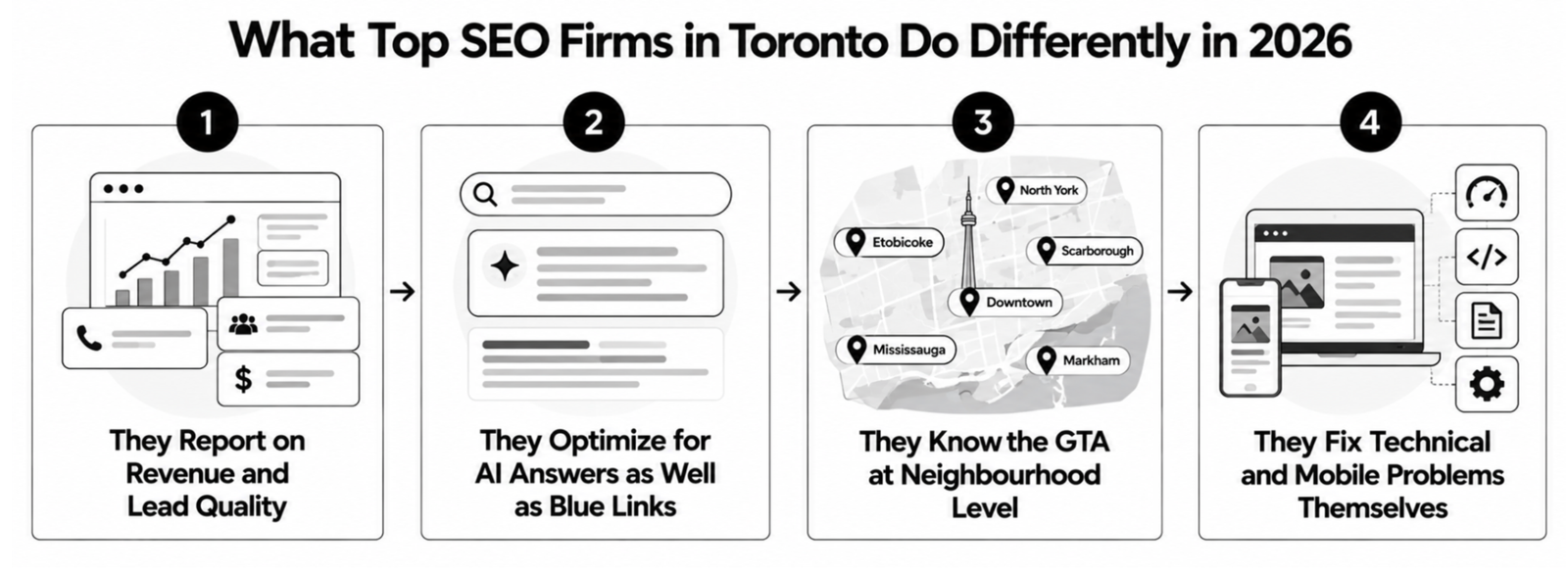
They Report on Revenue and Lead Quality
A ranking report tells you where you appear. It doesn’t tell you whether anyone called. Strong firms connect organic search to qualified enquiries, booked consultations and closed deals, ideally inside your CRM. They’ll also tell you when traffic went up but lead quality went down, which is the conversation weaker agencies avoid. If you want a model for that kind of reporting, see our guide to measuring the ROI of generative engine optimization.
They Optimize for AI Answers as Well as Blue Links
Answer engine optimization (AEO) means structuring content so AI tools can lift a clear answer from it: short definitions, direct 40-60 word responses, well-labelled tables. Generative engine optimization (GEO) means building the reviews, mentions and citations that make an AI model name your business when someone asks for a recommendation. A good firm treats both as part of SEO, not as a separate upsell.
They Know the GTA at Neighbourhood Level
Toronto search behaviour varies sharply by area. Someone in North York searching “accountant near me” gets different results from someone in the Downtown Core, and suburban searches across Mississauga, Brampton and Markham play out differently again. Top firms build service-area pages, Google Business Profile categories and local content around the neighbourhoods you actually serve, instead of one generic “Toronto” page. A quick test: ask which three neighbourhoods they’d prioritize for your business and why. A firm that knows the city will answer with specifics about competition and demand, not a list of postal codes.
They Fix Technical and Mobile Problems Themselves
Plenty of local searches happen on phones, so a slow or awkward mobile site loses customers before content has a chance to work. The better firms don’t stop at an audit. They fix crawl errors, page speed, broken redirects and schema markup (code that labels your business details for search engines) directly, or work hand in hand with whoever runs your site.
Those four habits are easy to claim on a sales call and much harder to prove. The way to tell the difference is to ask specific questions.
Questions to Ask Before You Hire a Toronto SEO Agency
Google’s “Do you need an SEO?” page includes its own list of questions, including “What’s your experience in my country/city?” That one alone screens out a lot of agencies that sell the same plan to every market. Here are five questions built for Toronto in 2026, and what a good answer sounds like.
Can You Show Me Work I Can Verify?
Ask for case studies with named clients you can call, or at least results they’ll walk you through in a live Search Console or analytics account. If they offer an audit first, Google advises giving read access only to Search Console at that stage, without write access. A firm with real results won’t mind the scrutiny.
How Do You Adapt for AI Overviews, ChatGPT and Perplexity?
A strong answer covers three things: solid technical SEO, content written in direct, quotable answers, and work on reviews and third-party mentions. Bonus points if they track which prompts cite you and which cite competitors, the way an AI brand visibility audit does. A weak answer sounds like magic.
How Do You Handle GTA Citations and Local Links?
Citations are listings of your business name, address and phone number (NAP) on directories such as Yelp.ca, YellowPages.ca, Canada411 and the Better Business Bureau. Ask how the agency keeps those consistent, especially if you’ve moved or rebranded. For links, listen for local sources: business improvement areas, chambers of commerce, community sponsorships and Toronto media, rather than bulk link packages.
What Will I See Every Month, and What Will It Cost?
You should know exactly what you’re paying, in CAD, and what gets delivered for it. Ask for a sample monthly report. It should show completed work, leads and enquiries, and the plan for next month, with rankings as one input rather than the headline. Then ask who writes that report and who you’ll speak to each month. If the answer is an account manager who relays questions to a team you never meet, expect slow answers when something breaks.
Will You Share Every Change You Make?
This one is lifted almost word for word from Google’s list: “Will you share with me all the changes you make to my site, and provide detailed information about your recommendations and the reasoning behind them?” Ethical, white-hat agencies follow Google Search Essentials and have nothing to hide. Hesitation here is an answer in itself.
The way an agency handles those five questions will also surface most of the warning signs below.
Red Flags When Choosing a Toronto SEO Partner
Some agency habits should end the conversation no matter how good the pitch sounds. They’re the “risk damage to your site and reputation” half of Google’s warning. The following are the three that come up most often in Toronto sales calls.
- A guaranteed #1 ranking. Google is blunt on this: “No one can guarantee a #1 ranking on Google.” The same goes for guaranteed AI citations.
- Opaque reporting tied to a long lock-in, where you can’t see what was done and can’t leave if it isn’t working.
- One package for everyone, with identical deliverables for a Leslieville café and a Mississauga logistics firm.
Not every minimum term is a trap. A three or six month minimum can be reasonable, because SEO takes time to show results, as long as the deliverables are written down and reporting is open. The problem is a long contract paired with work you can’t see. Avoiding the red flags gets you to a shortlist. Picking from it comes down to fit, which is where Gowishy comes in.
Why Gowishy Is Built for How Toronto Searches Now
Everything above describes how we think an SEO partner should work in 2026, and it’s how Gowishy is set up. Instead of one SEO contact handing work to other vendors, you get a dedicated pod on one monthly investment. Here’s what that means in practice.
The pod has six roles: an SEO Specialist, an AEO and GEO Strategist, a Content Strategist & Writer, a Product Marketing Strategist, a Web Designer and a Web Developer. Between them they cover the four habits from earlier: reporting tied to leads, content built for AI answers, GTA-level local work and technical fixes shipped directly. Our process runs Understand, Position, Map demand, Build and Grow, because, as our team puts it, “We do not start with keywords. We start with the business.”
To be fair, a pod isn’t for every business. If you run a single location and only need your Google Business Profile cleaned up, a local specialist may cost you less. If you need SEO, AI search and local authority working as one plan, we’d like to hear what you’re building.
Google framed the decision as visibility and time saved on one side, damage on the other. The best SEO company in Toronto is the one that can show you which side its work lands on, every month. If that’s the conversation you want to have, talk to us at Gowishy.
Frequently Asked Questions
The questions below come up in almost every first conversation with a Toronto business comparing SEO companies. Here are short answers to the five we hear most.
How much does an SEO company in Toronto cost?
Costs vary widely with scope, competition and how many locations you serve. A single-location local campaign and a multi-city B2B program are different jobs. Ask every agency for a written list of monthly deliverables in CAD, so you’re comparing the work itself rather than a headline price.
How long does SEO take to work in Toronto?
Technical fixes and Google Business Profile updates can show results within weeks. Content and authority usually take several months, longer in competitive categories like legal, real estate or home services. Google itself suggests asking any SEO what results to expect and in what timeframe, so ask that question directly.
Can an SEO company guarantee first place on Google?
No. Google states that “No one can guarantee a #1 ranking on Google.” Rankings depend on competition, search intent and algorithm updates no agency controls. Treat any guarantee of top rankings, or of AI citations in ChatGPT or Perplexity, as a reason to keep looking.
Do I need a separate agency for AI search optimization?
Usually not. Google says SEO best practices still apply to AI Overviews and AI Mode, so AI visibility builds on the same foundations. The best SEO companies in Toronto now include AEO and GEO work, such as direct-answer content and review building, within one plan.
Should I hire a local Toronto SEO company or a national one?
If local customers drive your revenue, local knowledge matters. A Toronto firm knows how searches differ between neighbourhoods, which Canadian directories count and which local media and organizations are worth links. A national firm can work if it shows clear experience in your city.
Related articles
-

How Much Should a Toronto Small Business Actually Spend on GEO?
Most Toronto small businesses should expect GEO quotes somewhere between $1,500 and $5,000 CAD a month, with multi-location and highly competitive businesses going past $5,000. Treat those as typical market ranges, not a price list. We haven’t seen an independent, published survey of GEO pricing in Canada, so the figures in this guide are estimates…
-
5 AI Search Optimization Tips Toronto Businesses Can’t Ignore (AEO and GEO)
An awkward admission for an agency to make: there is no secret trick to getting your business named by ChatGPT or Google’s AI Overviews. Google says so itself. Its guidance for site owners states that “there are no additional requirements to appear in AI Overviews or AI Mode, nor other special optimizations necessary” (Google Search…
-

How to Master AEO and GEO for Small Business in Toronto: A Success Guide
The story in this guide is hypothetical. The clinic is invented, and so is everything that happens to it. Every step it takes, though, is a real part of AEO for small business in Toronto, and one you can start this month. Picture a two-location physiotherapy clinic, one on Queen Street East in Leslieville and…