


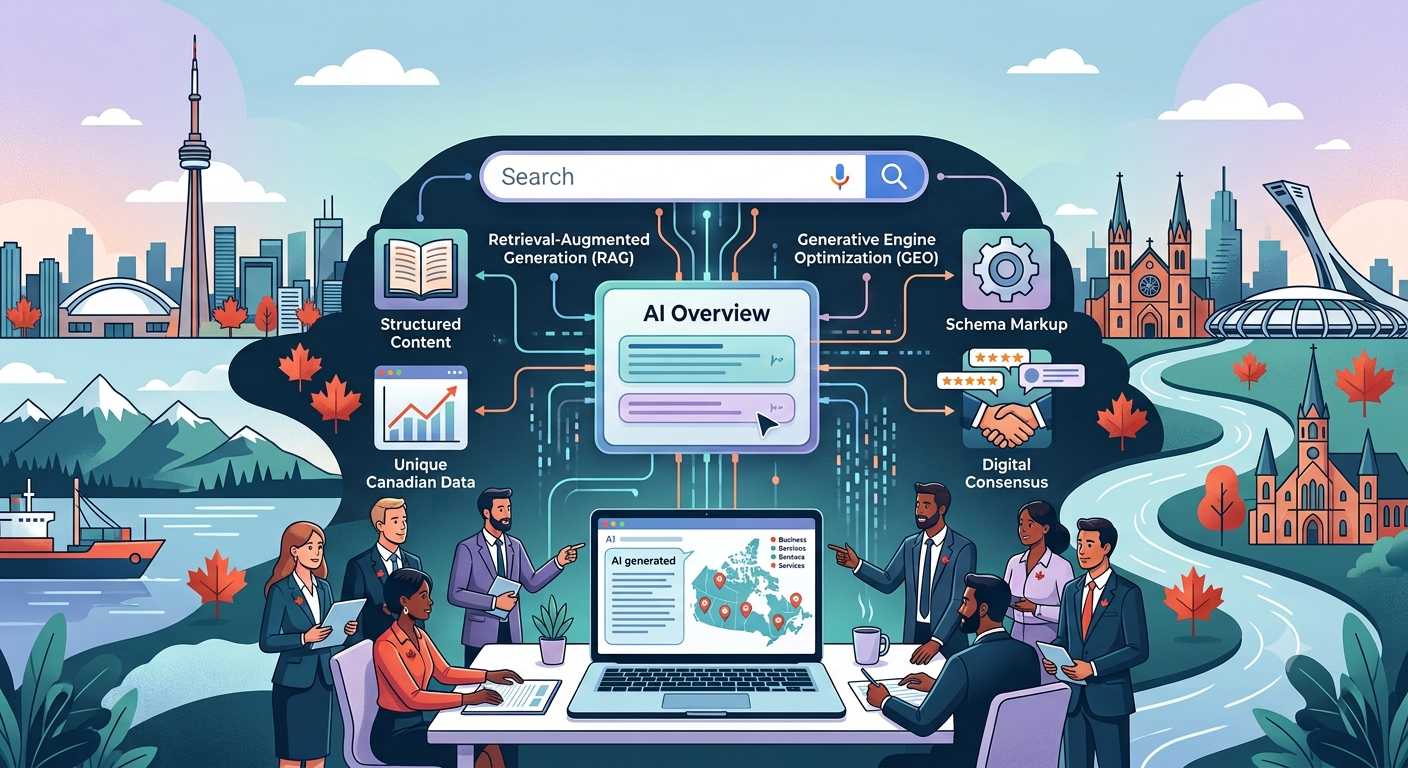
The Guide to Ranking in Google AI Overviews & LLMs

Google’s search results look a lot different than they did a few years ago. The first result isn’t a blue link that provides you with the most relevant result anymore. It’s an AI-generated summary of what you searched about. For Canadian businesses that have grown accustomed to the old strategies, this shift is a major hurdle in their traditional strategy. But played correctly, it also represents a huge opportunity at growth.
If you’re trying to figure out how to rank in these AI overviews, then what you need to understand is that generative answer engines aren’t trying to evaluate pages in the way you’re used to. They aren’t seeing the quality of your backlinks or what the keyword density is. They’re reading, extracting, and generating factual information so they can answer a user’s prompts directly.
Whether you’re operating in Toronto, Vancouver, Montreal, or even nationwide, your method of adapting to this new search landscape needs to be tailored to your specific business and your needs.
What are Google AI Overviews and Why Do They Matter in Canada?
Google AI Overviews pull information from multiple sources to give users a comprehensive, conversational answer. Instead of forcing users to click through three different websites to piece together a solution by themselves, AI overviews summarizes the most important information and provides direct citation back to the original sources.
For Canadian brands, this shift changes how clients discover your business and employ your services.
When an AI overview answers a user’s prompt directly, traditional click counts drop, and that’s a fact of the current AI era. While raw click volume may decrease, but that doesn’t mean clicks are insignificant. The users who do click the citations are significantly more likely to convert, since the AI model has already done the heavy lifting and validated your brand as high value for the user to trust.
Canadian searchers frequently ask questions bounded by local regulations, geographical constraints, or Canadian pricing.
4 Core Strategies to Rank in Google AI Overviews
To get your content cited inside AI Overviews, align your web architecture with how generative models retrieve information.
1. Structure Content for RAG and Vector Retrieval
Modern answer engines rely on Retrieval-Augmented Generation (RAG) to pull real-time data. The system breaks down a 1,000 word article into smaller chunks and processes it.
To ensure your content survives this process, write 100-to-300-word sections with clear headers and direct facts. Lead with the main takeaway in the first sentence before adding details. Keep the writing tight and without generic fluff.
2. Focus on “Information Gain” and Un-Copyable Data
LLMs synthesize what’s already known on the internet. If your article is just repeating the same facts as other blogs, then the AI engine has no reason to cite your website.
For citations, publish content that offers unique information, like original research, Canadian market surveys, and proprietary data. Incorporate case studies with real world outcomes for Canadian clients, alongside direct quotes and strategic commentary from industry experts. This promotes your source as original for the AI engine and then refer your brand to the user.
3. Deploy Comprehensive Schema Markup
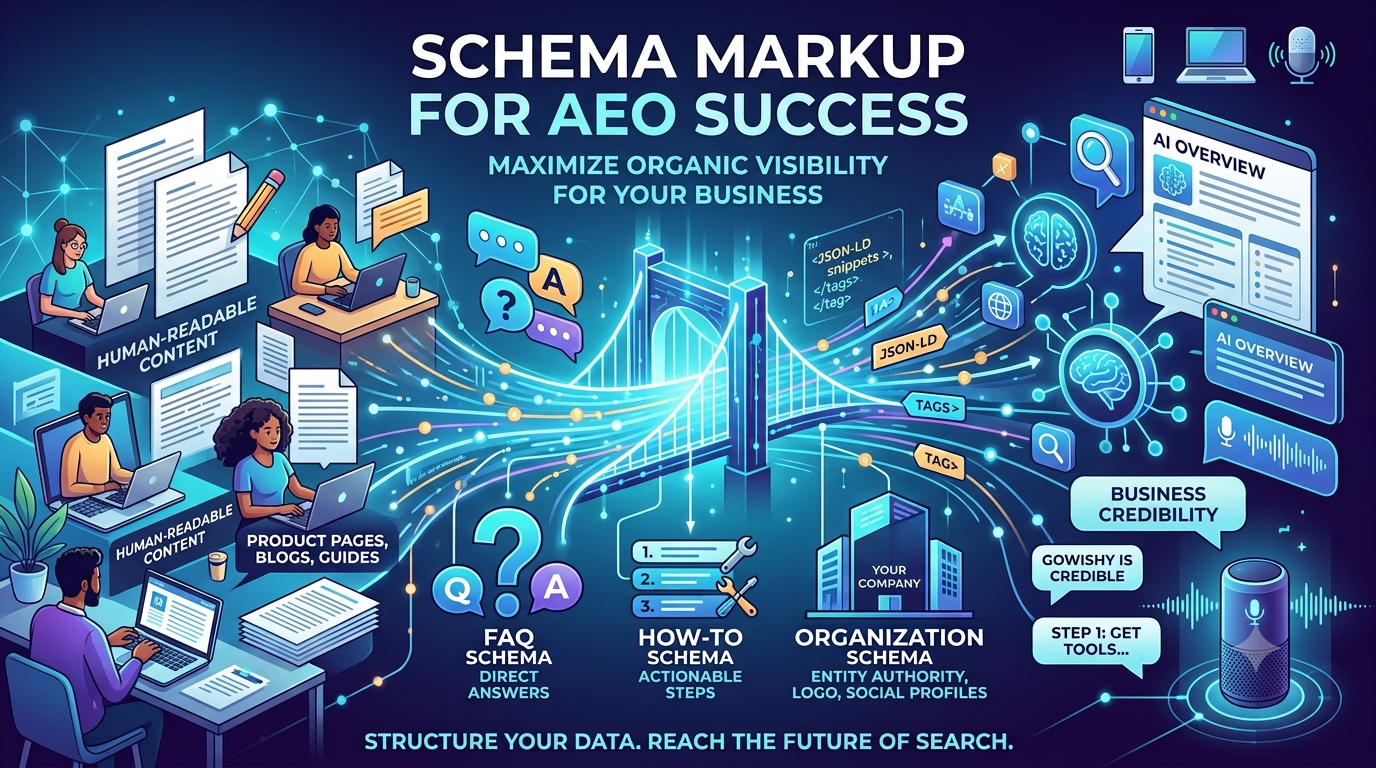
Schema markups act as a translator between your website code and machine algorithms.
Implement Organization Schema to define your brand name, logo, office locations, and social profiles. Adding FAQ schema that allows question and answer pairs lets AI overviews extract information easily for conversational queries, which help you rank higher with the LLM.
4. Build Strong Off-Page Digital Consensus
Generative models scan an entire ecosystem of unlinked brand mentions, review platforms, news outlets, and forums.
If third-party Canadian publications and community discussions discuss your product or service, the AI model is going to take that market consensus and recommend your company when users ask for the best solutions.
Moving Beyond Traditional SEO
Traditional SEO used to focus on ranking for static blue links to earn clicks. This meant measuring success through organic keywords and total traffic.
But AI SEO and GEO (Generative Engine Optimization) aren’t shooting for the same metric. They’re looking to earn direct citations and brand recommendations inside AI summaries.
Success is measured by AI Share of Voice, frequency of citations, and pipeline revenue. The strategy prioritizes answering complex prompts, providing deep coverage on a topic, and establishing consensus with structured data from off-page sources.
Future-Proof Your Brand with a Trusted Canadian Partner
In the era of generative search, winning requires combining deep engineering, RAG content structuring, and strategic brand positioning.
As a specialized CanadaGEO and AI SEO company in Canada, Gowishy helps businesses across the country adapt their digital footprint in this new future of search. Our focus is on building real topical authority and securing high-intent visibility inside the exact AI tools that your potential buyers are using everyday.
If you’re looking for help in optimizing your website for Google AI overviews and other modern LLMs, talk to us at Gowishy. We’re here to listen and then create a strategy tailored to your needs.
Related articles
-
Toronto’s Premier Answer Engine Optimization (AEO) Agency: Leading the Shift to AI-First Visibility
As Gen-AI transforms how people and companies discover information, traditional strategies are stepping aside to Answer Engine Optimization (AEO) and Generative Engine Optimization (GEO). If you have a brand and it isn’t being synthesized, recommended, and cited inside the latest tools like ChatGPT, Claude, Perplexity, and Google AI, you’re becoming invisible to a large part…
-
The Ultimate Buyer’s Guide: How to Hire an SEO Agency Without Getting Burned
When you hire an SEO agency, it should be a deliberate decision that creates a genuine opportunity for your business. But all too often, for most business owners, it ends up feeling like a gamble, with aggressive sales pitches, over-the-top promises that never materialize, vague promises of top rankings, and dense technical jargon designed to…
-
Retrieval-Augmented Generation (RAG) Explained: How AI Engines Actually Pull Your Data
Think of the internet as an infinite, unorganized filing cabinet, and a large language model as an executive with a terrible memory. If you ask that executive a question about something that happened yesterday, they’re not going to be able to rely on something they learned in school. They’re going to ask their assistant to…