As a content marketer, I can tell you, content marketing was built on a simple assembly line model: pick a target keyword, write an 800-word blog post, publish it, and move on to the next topic. This linear, post-by-post strategy worked well enough when traditional search engines were simply trying to match single keywords to standalone pages.
As a content marketer, I can tell you, content marketing was built on a simple assembly line model: pick a target keyword, write an 800-word blog post, publish it, and move on to the next topic. This linear, post-by-post strategy worked well enough when traditional search engines were simply trying to match single keywords to standalone pages.
However, the way people search for things has fundamentally changed. Today’s search engines and AI answer engines don’t just index isolated pages; they understand entities, relationships, and holistic topic depth. They synthesize complex answers from comprehensive sources rather than directing users to fragmented posts.
If your strategy still treats content as a collection of individual blog articles, you’re missing out on major organic opportunities. Modern search success requires transitioning from scattered blog posts to interconnected content hubs.
Why Single Blog Posts Fall Short
The standalone blog post model creates a few distinct problems for both users and search engines:
- Information Fragmentation: When relevant topics are scattered across dozens of individual posts published months apart, users have to jump through those posts to get a complete answer, which is undoubtedly frustrating.
- Cannibalization: Over time, publishing multiple separate posts on related topics leads to competing against yourself in search results.
- Diluted Domain Authority: Isolated posts rarely build the contextual depth search algorithms look for when deciding which site represents an authority on a subject.
Answer engines favor sources that demonstrate complete coverage of a subject area. When an AI engine generates a comprehensive answer for a user, it draws from structured, interconnected ecosystems of information, not isolated paragraphs buried in a forgotten archive.
What a Modern Content Hub Looks Like
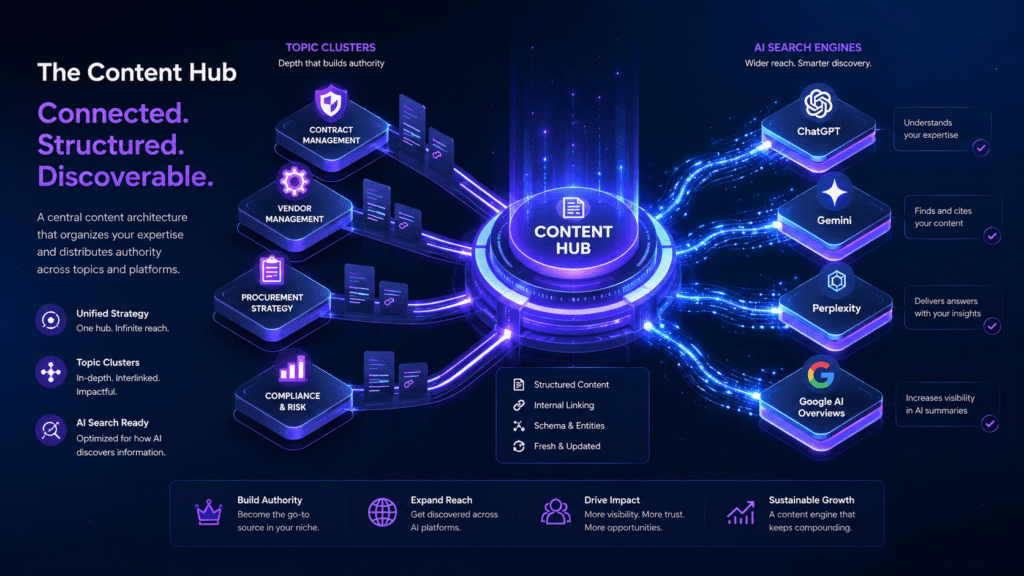
A content hub is a centralized framework that organizes your expertise into a clear, hierarchical ecosystem. Instead of treating every piece of content as a standalone unit, a hub architecture groups pages into logical clusters:
- Pillar Pages: High-level, comprehensive resource pages that cover a broad topic from every angle.
- Cluster Pages: Specialized sub-pages that dive deep into specific subtopics mentioned on the pillar page.
- Hyper-Connected Internal Links: Strategic internal linking that explicitly connects every cluster page back to the main pillar and to its sister topics.
This structure tells both human readers and search algorithms exactly how your content fits together. It’s clear, organized, and designed to answer primary questions while immediately offering logical next steps.
Key Benefits of Rearchitecting Your Content
Moving to a hub-based content model transforms how both users and search engines interact with your website.
1. Enhanced Entity Recognition and Topical Authority
Search engines use natural language processing to map topics. When you organize content into dedicated hubs, you’re helping search engines map your domain’s specific expertise. By covering every subtopic in depth and linking them in a structured manner, you signal your site is a primary authority in that domain.
2. Improved User Experience and Dwell Time
When a user lands on a standalone blog post, they often hit a dead end after reading. But when they land on a page that’s part of a well-designed content hub, they can navigate related subtopics without having to search again.
This keeps readers on your site longer and builds deeper brand trust.
3. Better Compatibility with Answer Engines
AI answer engines look for authoritative information patterns. They prioritize sources where concepts are clearly defined, categorized, and interlinked. A content hub acts as an open, structured database that answer engines can easily read, synthesize, and cite as a primary source.
How to Build a Content Hub Architecture
Transitioning to a hub model doesn’t mean deleting your existing blog. In fact, most companies already have the raw materials they need buried in their archives.
Step 1: Group Existing Content into Topic Clusters
Audit your existing library and group your posts into 3 to 5 core categories that reflect your core offerings. Look for overlapping themes, natural progressions, and gaps where important subtopics are missing.
Step 2: Build or Designate Pillar Pages
For each core topic, create or update an umbrella pillar page. This page should provide a clear overview of the macro-topic while introducing every key subtopic with brief summaries.
Step 3: Connect the Architecture with Contextual Links
Link every cluster post to your pillar page using clear and descriptive anchor text. Then, link the pillar page directly out to each cluster post. Finally, add horizontal internal links between related cluster posts. This creates a bidirectional Web of information that search crawlers can easily traverse.
Step 4: Fill the Content Gaps
Once your initial hub is mapped out, you’ll immediately see where your coverage is thin. Use those gaps to drive your upcoming content calendar, ensuring every new piece you write directly strengthens an existing hub.
Conclusion
The era of chasing search rankings with isolated, one-off blog posts is behind us. As search technology shifts closer to conversational answer generation, content architecture becomes just as important as content creation.
Rearchitecting your website around structured content hubs isn’t just about keeping up with changing algorithms. It’s about giving your audience a better, more cohesive experience that establishes your brand as the definitive resource in your industry. And in the end, regardless of what algorithmic changes search engines may do, that will remain a core pillar of good content marketing strategy.
If you need assistance in turning scattered articles into an interconnected, high-authority content hub, talk to us at Gowishy and let’s future-proof your digital architecture.
Stop Siloing Your Search Strategy
Why hire a solo SEO expert? Winning in AI search requires a unified engine. We bring content, design, technical SEO, and development into one seamless growth team.
Get Your Growth Plan arrow_forward